Wednesday, May 7, 2014

Morocco--Final Day of Birding: Massa and Massa Estuary

Since it was our last day of birding, we were on the road at 6:30 AM to make the hour drive to Massa where we hoped to pick up brown throated martin, which is similar visually to our northern rough-winged swallow.  When we arrived at the key spot we found some construction work underway, but we were able to walk down the river bed.  Very soon after we reached a promising bank that had a few nest holes in it we saw 3 martins flying up river towards us.  Unfortunately, while we got a pretty good view of them, they quickly flew right on by us.  We waited a bit in hopes that they would return, but they did not so we ended up with no photos.

With the brown throated martin now on our trip list, we still had 1 bird that had eluded us--black-bellied sandgrouse .  We drove a short distance to a site that had been good for them in the past.  As we approached Mustafa saw 2 flying not too far off.  We got out to begin working towards where we had seen them land.  In our desire to not miss them, we did not stop to all look at a tawny pipit that Martin found just as we got out of the van.  It ended up being on our trip list but seen by almost none of us.


We kept moving slowly towards where we had last seen the 2 sandgrouse, and happily many more began to arrive.  Once we got close enough to the spot we understood the attraction--there was a small seep and they were coming in to drink.  It is amazing how this fairly large bird blends in so well with the ground around it (all photos in today's post were taken by Laura except for 1.  Click on any photo to enlarge).  We were able to spend a good period of time watching the flock of black-bellied sandgrouse before they had drunk enough and took off.


It began to rain as we got back into the van to move onto a new area further down the river.  Unfortunately, the rain which was really the first we had experienced during the trip, kept up enough to make birding somewhat difficult.  We found a zitting cisticola, and did turn up a few warblers at one spot including Cetti's, western olivaceous, Orphean and Sardinian (just below).


There were women bringing back some plant they had harvested before the rain began (my photo).


We proceeded a bit further along to some fields where we heard a black-crowned tchagra calling.  We got out to try to track it down.  It kept moving away from us, but we did find a few other birds that were a bit rain soaked.


First up was a stonechat, and then a cirl bunting.


 Next we found a damp European goldfinch.


A common sandpiper popped up on a small mound.  In the river we had good looks at a Moroccan cormorant.


It was getting to be lunch time, so we went to a new spot to eat.  The rain stopped, and the sun even came out which let us bird while lunch was being fixed.  The first bird seen was a black crowned tchagra which made up for the one we missed earlier in the day.  We all finally got good looks at it which we had not been able to do several days previously when we had a fly by glimpse of one. While enjoying the tchagra, we also got a very distant view of a wryneck--also a bird that some had missed earlier in our trip.


The sun did not stay out, so after we gladly said goodbye to the last lunch of the tour, we decided to drive around to the beach where the Massa river estuary was located.  Along the way we spotted our 7th little owl of the trip,


By the time we reached the beach the sun was fully out again.  We immediately saw a few sanderlings feeding along the beach wave line. We walked down to the estuary, seeing a few more birds as we went including a crested lark.  At the estuary we were intercepted by a "ranger" for the preserve who told us we could not walk any further out towards the water.  As a result, we walked out to the edge of the beach where we found some birds roosting including 15 red knots.


Laura had not initially come out with us, but she followed a bit later, and got a record shot of us walking back.  A peregrine falcon came up the beach with us.


Even though the rain had hindered our birding for a bit, the day ended on a high note as we walked back to the van enjoying the bright sun.  We returned to La Pergola in time to freshen up before gathering for our last dinner.  Marty, Bill and I cracked open a bottle of Glenfiddich scotch to celebrate the success of our trip before going to eat.  The salad trolley kicked things off again followed by lamb brochettes with frites and other cooked vegies.  Chocolate cake topped off the meal.


We did our last bird list review which included some photos Martin had put on his computer.  It made for a very nice wrap up.  The final count for the trip was 226 species or sub-species which might have been a new trip record, but Adrian did not know for sure.  More importantly, we saw all the key endemic species, and only missed 2 birds that normally are found--lanner falcon which we might actually have seen one morning near Boumalne, but the bird flew off too quickly to identify it; and lesser short-toed lark.  My personal list was 222 birds seen and/or heard of which 124 were life birds for me.  Martin joined me and Marty for a nightcap which finished off the scotch.

The next morning we said our farewells to Mustafa, and boarded our plane to Casablanca where we all caught our Royal Air Maroc flight back to New York City.  Everyone seemed to have had a great trip, and I was very happy to have been able to visit Morocco one more time.  The birding had been excellent; the country and culture most interesting and enjoyable; and Adrian, Martin and Mustafa had been fine leaders.  I would highly recommend this trip to any birder.

I am off later today to Ohio where I will see Laura, Dan and Doreene again as we take in the spring migration at Magee Marsh and surrounding hotspots.  Stay tuned!

Monday, May 5, 2014

Morocco--Day 16: Arghoud Beach, Cape Rhir, Tamri and the Souss Estuary

After another fine breakfast, we said our goodbyes to Latifa and her husband Said, and to the English woman, who was spending a week in the area, that we got to know a bit while having dinner and breakfast at La Maison Anglais.  We had some driving to reach the other side of Agadir which has become the sardine fishing capital of the world.  Once we reached the Atlantic coast, we stopped at Arghoud beach to see what was about.   


There was a group of mostly lesser black-backed gulls loitering with the occasional yellow-legged gull mixed in.  We also found some lovely Audouin's gulls with their red and black beaks (all photos in today's post were taken by Laura.  Click on any photo to enlarge).


While scanning the water we found a few gannets feeding very far out, but the surprise was a raft of balearic shearwaters which number only about 2000 pairs in the world.  This was a great pick up for our trip, and a life bird for all of us.


We continued up the coast to reach the breeding area for the northern bald ibis of which there are now only about 500 still in the wild.  Their habitat has been greatly reduced to where they live in a very small area along the Atlantic coast near Agadir.  Whereas in the U.S. we would expect to find an ibis feeding in a wetland or wet fields, the northern bald ibis prefers sandy semi-arid land that also may have some grazing and small agricultural plots mixed in.


We stopped at Tamri to scan the estuary, but found no ibis present.  We drove another 15 minutes up the road to reach an area near the breeding cliffs.  As soon as we came upon the right habitat we began to see ibis.  We got out of the van, and spent the next 15 minutes watching as many as 20 of the birds feed, and move at times to a new spot to eat.  Their feathers were most beautiful, but the bald head was not so great.


We turned around to work our way back to Agadir and our lodging.  First though we found a nice quiet beach to have some lunch, and to scan the water.


On our way into town we spotted a couple of purple herons taking in the warm sun.


About 2 PM we checked into our French owned hotel, La Pergola, located on the edge of Agadir, and then headed over to the Souss Estuary.   We were blessed with continuing sunny weather and many birds.  The greater flamingos were a big hit.


The pied avocets were also a crowd pleaser.


As we worked our way down the estuary we kept finding new birds including a common redshank.  We also found Eurasian curlews, black-tailed godwits, dunlins and curlew sandpipers, a Moroccan white breasted cormorant and a common shelduck.


The next really good trip bird was a collared pratincole that initially we saw sitting on the mud.  It took off and seemed to be heading away.  We kept watching as it got more and more distant, and figured it was going to just keep on going when it reversed direction and came back near us very quickly.  It settled on the mud again where it stayed for a bit until it was harassed by a lesser black-backed gull.  This time when it took off it did not return, but we did end up finding 7 different species of gulls in the same area including a surprise greater black-backed gull mixed in with the lesser, slender billed, black-headed, yellow-legged, Audouin's and mediterranean gulls.  We also saw sandwich, gull-billed and whiskered terns in the bunch.


As we were heading out we flushed a stone curlew, but the last great get for the day was barbary partridge.  We were thinking that we were going to miss this Mahgreb endemic since we were down to just one more day of birding, so you can imagine our elation when Mustafa pointed 1 out just to the left side of the van.  It of course immediately disappeared.  After 5 minutes many in the group still had not gotten good looks at it.  Martin said he thought it would work its was up the ridge if we played a tape of its call.  We just needed to be patient.  Sure enough after a few more minutes we were able to see as many as 4 birds.  The barbary partridge reminded us of a chukar.


We got back to our hotel about 6 which gave us time to freshen up before dinner.  The first course was either soup, or a salad concocted from several choices on the trolley.  Adrian had been raving about this salad course, and we were not disappointed.  The rest of the meal was another round of the famous lemon chicken tagine followed by creme caramel.


We did our bird list review and added another 11 new trip birds.  Martin also had his computer, and showed the group a photo of the mystery warbler from 2 days before.  Using an application on his computer, he walked us thru the key details of the bird based on a book he had that specialized in distinguishing field marks.  This book has no bird photos, just lists of these defining field marks.  The analysis showed that we had found a marsh warbler which is quite rare in Morocco.  With just 1 full day of birding to go before we would be heading home, we still had some more hoped for birds on our list to look for on our final day.  Stay tuned!

Saturday, May 3, 2014

Morocco--Day 15: Tioute, a Palmerie, Taroudant Souk and Freija

Because we were out late last night, we did not leave until 9 AM.  Our first stop was a visit to an Argan Coop which is run by Berber women.  The argan tree is indigenous to the Souss Valley region, and its nut is highly prized because it can be used in many different ways.  It has only been over the past 30 or so years that the Berber women have created several coops to process the argan nut which provides jobs for the women.

After harvesting the ripe nut from the trees, the next step is to get the meat out of the shell. The technology could not be simpler--a small stone tapping on the nut that sits on a larger stone.  The Berber women are very proficient, and we discovered that Laura had a real knack for it as well.  She might not be as good at cracking the shells as she is at taking bird photos, but she certainly proved to be better than any of the rest of our group who gave it a try (all photos in today's post are mine unless indicated otherwise. Click on any photo to enlarge).


We also toured the room where the nut meat is processed to create the oil which leaves an extruded material that kind of resembles peanut butter.  The oil is used for cooking, and in many body care products.  The cream I brought back has been a big hit with my wife.


On the way out I had to take a photo of this bike since it was so handsomely decked out.  We saw lots of bicycles in Morocco, but nothing quite like this one.
 

It was now late morning, and we had one birding spot to work through before returning to Taroudant to visit its souk.  It was a large palmerie that we spent over 2 hours meandering through.  First up was a pair of laughing doves (photo taken by Laura).


We came across mostly small birds working the palms, and the crops of beans and barley growing under them.  There were many willow warblers, a few moussier's and 1 common redstarts.  A serin proved to be a cooperative photo op for Laura.


After about an hour we heard the soft purring of a European turtle dove, and while walking around we had several wood pigeons fly over (both photos taken by Laura).


We finally found a whitethroat warbler which had only been seen by Martin a few days earlier in a different palmerie.  In the same area, Laura snapped a photo of a female blackcap warbler. As the sun rose higher, the temps climbed so we were ready to join Mustafa for our usual lunch at a small cafe in the palmerie that allowed us to use their wisteria shaded tables in exchange for buying a drink from them.


After lunch it was time to drive back to Taroudant to visit the souk.  We spent over 2 hours wandering through the market.  At one shop many of us bought spices to take home including saffron that sells for $15/gram in the U.S., but we were able to purchase for just $4/gram.


Other items picked up during our foray included shoes, scarves, a djellaba, ceramic platters and small knickknacks.  We noticed that as we moved through the souk, we would be approached by 1 or 2 of the same sales people.  Our guide explained that many of the shop owners, who did not speak english, would use these people, who could speak english, to help sell to foreigners.  If a sale was made, then the person would get a commission.


The market was certainly a very colorful place, particularly the shops selling food like grains or spices.  We all enjoyed the opportunity to spend some time in the souk, but it had to come to an end because we needed to eat an early dinner to leave time to try for the red-necked nightjar again.


The evening meal once again was superb.  Latifa, the woman who manages la Maison Anglais, had found pigeon to make a truly authentic bisteeya for us.  It was decorated with the traditional powdered sugar, cinnamon and almonds.  Just above it is a tagine of chicken.  We also had a  vegie cous cous, and a salad of chopped cukes, tomatoes and avocado.  Dessert was a dish of apples and pears with almonds and an apricot sauce.


Both Adrian and Martin assured the group that the nightjar that we had seen poorly yesterday evening was a red-necked and not a European.  So after going over the bird day list, which had only the European turtle dove as a new trip bird, just Dan, Laura, Martin and I decided to try a second time to see this bird mainly in hopes of getting good photos.  We returned to the same location where we had found the nightjar last night, a place called Freija.  We flushed one off the gravel road.  We relocated it about 200 yards away, but in our attempts to get close enough for a photo, we flushed it again.


Fortunately, we soon found it or another one.  This time we moved very carefully as we inched towards it.  It took a good 15-20 minutes, but we finally got extremely close so that Laura and Martin were both able to take many photos of it while Mustafa, Dan and I held up bright lights.  We finally had our fill, and slowly backed away from the bird.  It watched us the whole time, but chose to stay put.  We were more than ready to get back to our beds and a good night's sleep in order to be ready for tomorrow's birding near Agadir.  Our number one target bird would be the bald ibis.  Stay tuned!

Thursday, May 1, 2014

Morocco--Day 14: Souss River Valley and Aoulouz Gorge

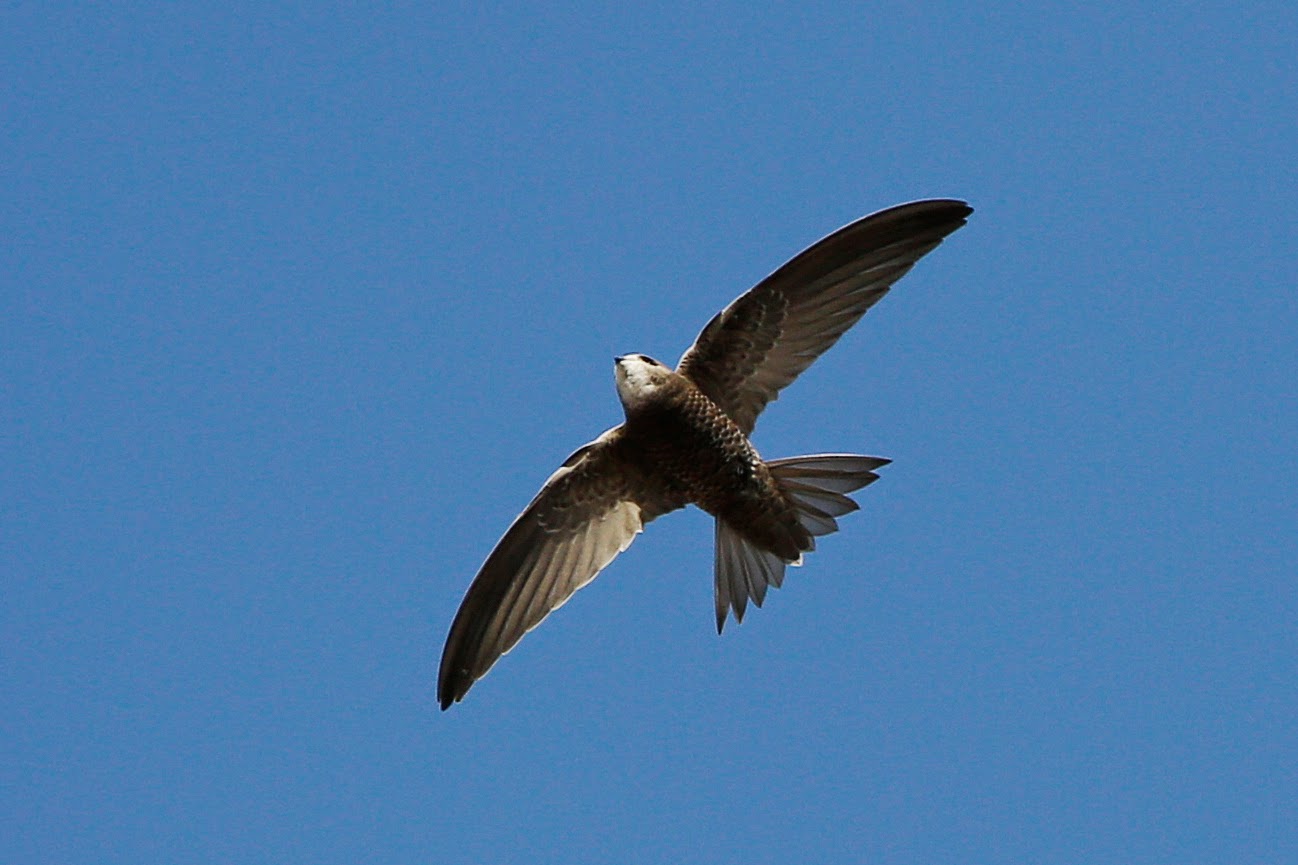
We were out by 8 AM after another typical Moroccan breakfast.  Adrian stayed behind in an attempt to recover from whatever he had come down with.  Martin was more than up to filling in again.  Our first stop was by the large walls in part of Taroudant where a small group of little swifts gave us an opportunity to compare their size, coloration and flight pattern to the more numerous pallid swift (second photo below; all photos in today's post were taken by Laura unless indicated otherwise.  Click on any photo to enlarge).


Once we had our fill of the swifts, we drove a short distance outside of Taroudant to walk a section of road that paralleled the Souss River wadi.  We found a few birds along the way including Sardinian and Orphean warblers, and many woodchat shrikes with their lovely rust colored caps.


As we walked along we spied in the distance a booted eagle lifting off to continue on its migration, and on the ground we came across a spur-thighed tortoise (my photo). 


Mustafa picked us up in the van to move to a new location, and as we were driving back out to the main road we ran into a group of 9 European bee-eaters that proved as colorful as the blue-cheeked bee-eaters we had seen a few days earlier. 


Our next spot was even less birdy than where we had just been with a few crested larks, a couple of grey shrikes and another Orphean warbler.  Then Mustafa signaled for us to come to the van.  He had just seen 2 fulvous babblers fly by which we relocated a little way down the gravel road.


It was getting towards noon, so we moved onto the Aoulouz Gorge.  While Martin and Mustafa pulled together lunch for us, we scanned a nearby section of the river.


A pair of colorful ruddy shelducks set the tone for what would prove to be a very good birding spot.  There were many little egrets and a few cattle egrets working the waterway.  Also a little ringed plover well camouflaged fed along the edge, and a much easier to see common greenshank.


We got to see our second gray wagtail of the trip, and our first Moroccan form of the white wagtail.


The rumble in our stomachs pulled us back to the van for a quick lunch before walking up the mostly dry river bed and into the gorge in search of birds of prey.  We already had seen a booted eagle soar overhead, and then a couple of common kestrels flew down off the cliff.  But our primary target bird at this location was barbary falcon, which is very similar to a peregrine falcon.


As we were scanning the cliff face, a man began walking along the top of the cliff which to our joy flushed a barbary falcon that we proceeded to watch for the next 10-15 minutes.  It would fly to the cliff face for a bit, and then fly out and around.  It eventually moved far enough up the gorge that we decided to move to the other side of the bridge to see what that part of the river had to offer.


It was now mid afternoon, and it had become quite hot under the blue sky and bright sun.  We found a gray heron, which is very similar to our great blue heron.  A sedge warbler flew across the water, and had our attention briefly before a kingfisher flashed into view with a fish in its bill.


We also found a reed warbler plus a second warbler that was clearly different.  Martin got some photos of it for later study.  A purple heron flushed and flew away before we could get a photo.  Another booted eagle flew far overhead. The group was beginning to flag a bit because of the heat, so we worked our way back to the van.


On the way home we stopped to look for Spanish sparrows.  We kept seeing groups of them flying away from us, but none would settle near us.  We did get good looks at a zitting cisticola though.  Finally, while not close, Laura was able to get a shot of a few Spanish sparrows feeding  in a wheat field.


We now needed to get back to our lodging to have dinner a bit earlier than normal since we would be going out again to look for red-necked nightjars.  Our meal proved to be simply outstanding.  A tagine of some kind of fish that was cut into "steaks" and covered with chermoula sauce plus 2 other kinds of smaller fish that were quickly fried (my photo).  If you look closely at the upper plate you can see that 1 of the fish is very tiny and the chef had tucked its tail into its mouth prior to cooking it.


Accompanying the fish dishes were carrot, cucumber/tomato, and fava bean salads plus bread and butter.  The dessert was a crispy pancake like confection covered with chocolate and nuts.  I believe that if I had taken a poll, the group would have voted this the best meal of our trip.

After dinner we quickly did our bird list review, and found we had added 9 new trip birds, and now had seen over 200 different species and sub-species.  With that to inspire us, we returned first to our initial morning stop to look for the nightjar, but did not locate one.  Next up was the area where we had found the fulvous babblers.  We kept shining our flashlights onto the shrubbery, and would find a number of spider eyes, but no nightjar.  Then Mustafa located a pair of eyes not far off the road.  He and Martin worked towards the spot, but the bird flushed.  With some more searching, Martin relocated it, but once again it flew off before we could get definitive views of it.  After another 30 minutes of looking, we decided to call it a night since we knew we could try again tomorrow evening.  Stay tuned!