Friday, April 1, 2016

San Blas, Mexico 2/24-26/16

On Wednesday morning we were up at 5 for breakfast and on the road by 5:30 to make the drive up into a coffee plantation that was no longer fully managed.  The elevation took us up out of the sea level habitat.  The bird viewing for the first hour was very active, but they were quite high up in the trees.  Golden-cheeked woodpeckers were abundant.  Other highlights included bat falcon, elegant euphonia, elegant and citreoline trogons, rufous-backed robin, happy wren, and western tanager.


The road through the plantation was a fairly rough cobblestone type that seemed very old, and very necessary if it has been raining.  We worked our way down the road, stopping and scanning as best we could through the heavy foliage. We picked up lilac crowned parrot, and saw gray-crowned woodpecker; greenish elaenia; boat-billed flycatcher; ivory-billed woodcreeper; western long-tailed hermit; and red-crowned ant-tanager.  Like most days of our trip we heard collared forest-falcon, but never once did we see one. Other heard only birds that morning included russet-crowned motmot, and colima and ferruginous pygmy owls.


After our siesta we visited crocodilo road which gave us a wide variety of bird life beginning with our first bare-throated tiger-heron of the trip.


We also had a northern jacana.


Groove-billed anis were around.


The first laughing falcon of our trip made an appearance, as did a black hawk.


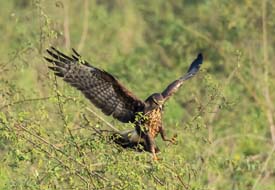
Driving into San Blas yesterday Dave had seen a crane hawk fly over that the rest of us missed, so we were very glad when one come by.


Other birds seen along the road included white-throated, willow and vermilion flycatchers; white-collared seedeater; lincoln sparrow; thick-billed and tropical kingbirds; orange-crowned, nashville, Macgillivray's, Wilson's and yellow warblers; and mangrove and northern rough-winged swallows. After a long and pretty toasty afternoon, we were more than ready to get back to the hotel for beers and dinner.

We were up even earlier on Thursday because we had to drive over an hour to a mid elevation site for our morning birding.  The area is called Cerro de San Juan.  Our main targets were various hummingbirds.  There were of course several white-eared, but we also picked up berylline.


The others included calliope, cinnamon and finally a bumblebee.  The best though was the Mexican woodnymph.


Two birds that had been eluding us were the rufous-crowned ground-sparrow, and the rusty sparrow.


We stopped at a high altitude ranch that had a large group of spotted wrens, and along the road we found our first stripe-headed sparrow of the trip.


After a picnic lunch in the cool highlands where we saw our first green jays of the tour as well as several warbler species like black-throated gray, yellow-rumped and rufous-capped, we drove down to sea level to find a marshy area that Dave had heard about.  We wandered around on back roads a bit before we finally located it, but it was well worth it.


There were a large number of black-bellied whistling ducks, but most amazing was the huge number of female and immature snail kites.

There were also many limpkins.


As the sun fell low in the sky, we made our way back to the hotel for more beer and good food which this time of year meant lots of variations on wild caught shrimp from the Pacific ocean (photo taken by Laura Keene).


Friday morning was not quite such an early start, but we were still on the road before 6 AM.  Our morning was spent walking along Singayta Road.  Since we were now on our 7th full day of birding, and 3rd in the San Blas area, the number of new species for us was beginning to decline.  The morning was very delightful nevertheless.   Some previously seen birds included golden-cheeked and gila woodpeckers; great kiskadee; red-billed pigeon; white-winged, white-tipped, and inca doves; groove-billed ani; cinnamon hummer; orange-fronted parakeet; and dusky, pacific-slope, and social flycatchers.


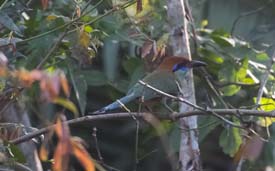
New seen birds for the trip included a great black-hawk, fan-tailed warbler, Mexican parrotlet, and russet-crowned motmot.

After our siesta we all piled into a small boat for a late afternoon until dark trip on Rio Tovara.  The first part had us follow the river out to its mouth.  Along the way we stopped and called out a rufous-necked wood-rail.  I also briefly saw a jaguarundi walking along the far side of the river, but it moved into the vegetation before I could get anyone else on it.


The main reason for the boat trip was to go up river through the mangroves to the large spring that feeds the river.  It was a beautiful evening, and with all the bird life it turned into a very magical time.


The number one goal was to find one of the strangest of birds--the boat-billed heron.  We located 2 roost areas.  A truly stunning bird, but such an odd bill.


Near dusk we found a white-tailed kite.  Just before that we had an unusual encounter with a merlin that circled over our boat time and again before finally disappearing. We almost felt like the bird was dive bombing us.

The other most interesting bird of the evening was the northern potoo.  Over an hour's time we encountered 8 of them.  It seems like the perch goes right into its stomach since you can not see its feet.  We also flushed a few paraques.


We ate later than normal, but no one was complaining after such a perfect tour of the river.

Thursday, March 31, 2016

Durango Highway, Mexico 2/20-23/16

When I visited Gambell and Nome in Alaska back in 2006, our guide in Nome was Dave MacKay.  I really liked his guiding style and skills, so we continued to stay in touch.  Dave lives in Alamos, Sonora, Mexico with his wife Jen.  I visited them in 2008, and again in 2009 when we joined him on what turned out to be 2 consecutive "big days" in Sonora.  My friend Marty was part of those 2 days, and his nephew, David Wilson--a documentary film maker--and his crew recorded the trip.  From the film footage, David made a 13 minute short called the Big Birding Day which was shown at several film festivals, and also ran on PBS.

I had wanted to do a birding trip guided by Dave in Mexico, so this past February I organized a group of some of my favorite birding friends (Bert Filemyr, Neil Hayward, Laura Keene, Doreene Linzell and Dan Sanders, and Marty Riback) to spend 10 days birding part of the Durango Highway, and the area around San Blas. Today's post covers the Durango part of the trip. All the photos were taken by Bert Filemyr unless otherwise indicated.

We all flew into Mazatlan on Friday the 19th so that we would be ready to start at sunrise on the 20th.  After scoping the ocean in front of our waterfront hotel, we ate a light breakfast, and then jumped into our van to start working our way up into the mountains by way of the Durango Highway.  Our first couple of stops were still at lower elevation where we saw 30-40 rufous-bellied chachalacas.


We also had our first sightings of citreoline trogons, and purple-backed jays.  Other birds included white-collared seedeater, grayish saltator, sinaloa crow, curve-billed thrasher, and blue-gray gnatcatcher.


We had chosen the end of February for the trip because the weather was normally dry and the air temp even at sea level would be comfortable.  As it turned out we got it half right in that we saw no rain, but temps in general ran about 10 degrees warmer than normal, so by the afternoons even in the mountains it was fairly toasty, and at sea level it meant we took a siesta.

On our first day at lower elevation it was very warm.  When we stopped in La Noria for a rustic lunch, I made the mistake of passing on the molcajete which may have been the most unique dish of the entire trip.  It is a hot broth poured into a heated volcanic rock bowl. Raw shrimp and some cheese are then added which cook in the steaming liquid.


As we made our way up to Copala where we would spend the next 3 nights, we stopped to check out various spots where Dave had had good success in the past.  In most cases we found the target birds, like the white-tailed hawk, and the ivory-billed woodcreeper, but not always.


Our hotel for the night was Daniel's which did quite well until they completed a new toll road that bypasses the town of Copala.  Also, the cruise ships would send day buses up to Copala, but with the increased news coverage of the drug cartel wars in Mexico, tourists were not so keen on making day trips away from the port cities.  As you can see, the room rates were extremely reasonable (when we were there a dollar was worth 18 pesos).


After walking up thru the village and having a simple dinner at Alejandro's, we returned to Daniel's to try to hear a mottled owl.  Our efforts proved fruitless, so we turned in for the night.  About 4:30 AM I heard the mottled owl calling outside my window, but when I got up an hour later to look for it, it had left.  We did have a non-stop calling ferruginous pygmy owl, but it remained well hidden in the thick foliage of the tree it was in.

We were on the road before sunrise to make the drive up to the tufted jay preserve which is at about 8,000 ft elevation.  We stopped soon after the sun was up near a lumber mill to check out some mixed habitat with particular focus on finding a bumblebee hummer, but none were there.  Instead we had a rufous hummer.


We did see many other birds like brown-backed solitaire, golden vireo, greater pewee, tufted flycatcher, white-throated thrush, and rufous-capped warbler.


We next stopped a short way into the preserve to check on a stygian owl roost, but the pair that had been seen there just a few days before were not around. We did see several warbler species including our first crescent-chested, hermit, Townsend's, black and white, and grace's warblers of the trip; ruby-crowned kinglet;  common raven; and Scott's oriole; and hepatic, flame-colored and red-headed tanagers.


As we approached the preserve entrance we found both green-striped and rufous-capped brush-finches.  Inside the preserve we did located both black-throated magpie jays and tufted jays.  The preserve was created because this is the only place the tufted jay exists.


While enjoying the tufted jays we heard and then found a mountain trogon. We also found our first white-striped woodcreeper.


Dave heard a less roadrunner calling which we were able to track down. In the same area we got brief looks at a russet nightingale-thrush.


Just before having lunch we also had unusually good views of the generally very skulky blue mockingbird, and nearby was a white-eared hummer on its nest. There were several gray silky-flycatchers at the preserve as well.


Instead of returning on the very windy old road, we came down the mountain on the much faster toll road where we found out first bat falcon for the trip.


Back in Copala we pretty much had a repeat of the night before with a simple meal at Alejandro's and once again could not turn up the mottled owl at dusk which might have been because of the party just down the hill from Daniel's which as it turned out went on all night.

The next morning we once again had the ferruginous pygmy owl calling repeatedly, and this time we were able to find its perch.  After another quick breakfast we once again went back up to the tufted jay preserve in hopes of finding the stygian owl, but to no avail.  We saw many of the same passerines from the day before at the owl location adding white-breasted and pygmy nuthatches.


We drove up to the preserve entrance again, and finally saw our first red warbler, later we had a zone-tailed hawk sighting.


We went part way back down the preserve gravel road to a turn off that took us down into a drainage where we had lunch.  At our lunch spot we had Scott's and Bullock's orioles.  We then walked down the drainage where we found a second golden-browed warbler for the trip, as well as several slate-throated redstarts and another red warbler.  This drainage had generally been a good spot for gray-collared becard, but not for us.


We stopped at Petaca on the way home to try for rusty sparrow and rusty-crowned ground-sparrow, but found neither one.  After returning to Copala, we walked one of the roads before dinner and finally got good looks at yellow grosbeaks.  One more dinner at Alejandro's was followed by another evening without a mottled owl showing up.


On Tuesday morning it was time for us to finish up our Durango Highway visit, so we spent the morning after our early breakfast at Panuco road.  One of the highlights was locating a colima pygmy owl which we had been hearing for a couple of days already.


We also found a Nutting's flycatcher that even opened its mouth which allowed us to confirm that it was orange. Other birds of note during the morning included military macaws; pale-billed woodpeckers; orange-fronted parakeets; black-throated magpie jays; thick-billed kingbirds; elegant trogons, and a heard only vermiculated owl.


Our drive to San Blas was about 4 hours, so by mid day it was time to move on.  As we returned to sea level, the bird life changed so we picked up enroute our first Harris's hawk.  Where the highway ran next to the Pacific ocean we began to see more waterfowl such as various egrets, herons. and waders.  Just as we approached San Blas we stopped at a wetland that had lots of water birds and of course crocodiles.


We were more than happy to reach Hotel Garza Canela which would be our home for the next 6 nights while we did our birding around San Blas.  And we were even happier to begin to enjoy the fine food that was offered daily on the hotel menu.

Tuesday, March 15, 2016

Zenaida Dove!!

On the 21st of February just after I had left for a 10 day birding trip in Mexico (blog post soon to follow), a zenaida dove (ABA code 5) was found at Long Key SP in the Florida Keys.  This is the same park that 2 Key West quail-dove were being seen for several months at the end of 2014 and into 2015.  I attended a documentary film festival in Missouri on my way back from Mexico, so I was not able to go to look for the zenaida dove until yesterday.


I flew down to Miami Sunday evening, and was at Long Key State Park when they opened at 8 AM yesterday.  Neil Hayward had sent me detailed info on where to stake out the bird.  And stake out is the correct term since it does return to the same part of the Golden Orb trail to feed, but only for a couple of minutes, and often just once or twice a day.

When I first arrived, I saw a dove down the trail, but it walked into the woods before I could get my binocs on it.  I walked up to the spot I had seen it last, but it was not visible.  Then I heard a dove calling, and found what turned out to be a common ground dove perched some distance away in a tree.

It was a pretty morning with some breeze coming off the water, so I settled in to watch for the zenaida.  I only had 2 catbirds and a pair of cardinals at first.  Then an ovenbird and a prairie warbler brightened my day.  Fortunately since it was a Monday, there were not a lot of hikers on the trail to scare off birds from coming in to seek seed and grit.  An occasional kayaker would come paddling by, and overhead 3 osprey would make periodic forays.  Of course now and again brown pelicans or magnificent frigatebirds would sail by.

About 10 AM I had my first mourning doves arrive to feed.  The zenaida dove looks very similar, but it is a bit bigger, a bit browner/darker, has a small white patch on the trailing edge of its wing, and a tail that is a bit shorter and more square compared to the mourning dove (photo below taken by Neil Hayward).


About 1 PM 3 birders joined me.  They were from MN, CO and CA. Just before 2 PM we suddenly noticed a dove feeding on the edge of the trail.  At first we could only see its head and the front half of its body which looked very similar to a mourning dove except it was browner.  We kept waiting for it to move into full view, and when it did we knew that it was the zenaida dove. It flushed into the woods, but soon returned for even better looks before flying off again.

When it did not return a third time, I decided it was time to make my way back up to Miami to catch my evening flight home.  I stopped at Everglades NP for a short walk at the Anhinga Trail.  It was pretty slow birdwise, but there were a few alligators.  Getting back to the airport proved uneventful, but I can not say the same for my flight home which departed 2 hours late.  I was finally in bed just after 3 AM.

Wednesday, January 13, 2016

Redwing AND Siberian Accentor!

A redwing (ABA code 4) was discovered on Vancouver Island, BC in late December.  Neil Hayward called me to see if I wanted to join him and Gerri on the 1st of January to try to see the bird.  I could not get away, but they were successful in finding it after 7 hours of diligent searching on January 2nd.  My friend Laura Keene, who is doing a photographic full ABA area big year, was there on January 1st to look for the redwing to begin her big year.  The photo below of the redwing was taken by Laura (click on any photo to enlarge).


I kept checking Narba on the redwing's status.  While difficult to see in the dense holly hedgerow, it was being found each day.  Then Narba reported that a siberian accentor (ABA code 4) had been found on the Christmas Bird Count in the town of Surrey which is a large suburb of Vancouver.  With 2 potential life birds so close together, I decided I needed to make the trip out to try to see both of them.  I caught a flight Friday afternoon the 8th to Seattle, and by 11 PM was settled into a motel in Bellingham, WA for the night.

I was up at 4:30 to make the drive on into Canada to catch the 7 AM ferry from Tsawwassen over to Swartz Bay which is about 30 kilometers north of Victoria where the redwing had been found.  I watched a beautiful sunrise on the ferry, and arrived at the redwing location about 9:15.  There were 5 other birders there including Olaf Danielson who is doing a full ABA area big year.  I was shown a photo that Olaf had been able to get, and was told that the bird had not been seen for at least 15 minutes.  We all kept looking for it to show itself again, but only one fleeting glimpse of it occurred which was not good enough for a definitive ID.

Sightings of the redwing in the holly had mostly been between 8 and 9 AM, and again between 3 and 4 PM, with some random visits during the day to the holly.  Otherwise it might be encountered anywhere in the general area, but the odds were much lower.

The other birders departed about 10, and I was left on my own under mostly sunny skies and a temperature of 40 degrees.  Sometime after 11 AM I was joined by Daniele, a birder from Vancouver, who had come over on the 9 AM ferry.  He told me he had seen the siberian accentor the day before, and that it was still being seen that morning. My hope was to see the redwing today, and then be able to look for the accentor the next day.

We patiently kept up our vigil, watching many different birds moving thru the holly as well as flying overhead, but no sign of the redwing. About 2 PM a few other local birders began to come by in hopes of seeing the redwing when it returned to the holly for the night. About 3 PM 2 birders I know from Texas, Nick Cooney and Lucie Bruce, stopped to say hi.  They had seen the redwing in the morning, but had left the site before I arrived.  We had last seen each other in Florida in October looking for the variegated flycatcher.


After 4 PM most of the other birders slowly departed.  I stayed until 5 PM, as did Daniele, but we never were able to find the redwing.  We did see a total of 37 bird species though during our stake out. By then I was so cold from standing around all day on wet, cold ground that I was more than ready to check into a motel, and get into a hot shower.

I was up early, and back on watch by 8 AM.  Daniele arrived soon after, and then a couple of other birders as well.  About 8:30 Daniele briefly saw the redwing along with a woman from the area, but it moved back into the holly before I could find it.  20 minutes later Daniele saw it again, but again I was not quick enough to spot it before it disappeared.

I left about 10 to go have breakfast and warm up.  I ended up watching the Seattle Seahawks lucky win over the Minnesota Vikings when the Vikings place kicker missed a last second short field goal attempt.

I was back at the redwing site by 2 PM.  Unlike in the morning when it was overcast, this afternoon was beautifully sunny. I found several local birders including Ann Nightingale who had set the big year record in 2015 for Vancouver Island.  She told me she had seen Neil and Gerri the previous weekend.  About 3:45 the redwing was spotted by 1 birder, but then it hid before anyone else could get on it.  A little after 4, the same thing happened again.  I finally threw in the towel at 4:45, and checked back into my motel for a 2nd night.  After 14 hours of looking for the redwing, and the near miss sightings, I was beginning to feel like when I was searching for the Key West quail-dove in Florida back in December of 2014.

I arrived Monday at 8 AM under overcast skies, and was joined by Wayne Weber and Ann Nightingale from the day before. Soon after a car drove up.  Dottie Robbins from Florida, and Liz Southworth from Massachusetts--both of whom I know--joined us.  About 9 AM Liz saw the redwing, and this time it stayed out in the open long enough for all of us to get on it.  Over the next 30 minutes we were able to see it well a couple of more times.

The day before Liz had been able to see the siberian accentor, but Dottie had not arrived in time to visit the accentor location, so we all decided to get back on the ferry to return to Surrey to look for the other bird.  After a nice ferry ride where we were able to watch various seabirds, we drove 30 minutes to the accentor site.  We arrived to find 10-15 birders standing in the rain.  We were told that the bird had just been seen for the first time that day.  We got out our umbrellas, and joined the group.  When the bird was not immediately relocated, several birders departed, but there were still a half dozen of us to scan the area.  Fortunately, the accentor was soon found only about 100 yards away sitting up in a tree.  My views were not great, but I could definitely see the key field marks to identify the bird.

With the rain falling steadily, I bid farewell to Dottie and Liz, and began the drive back down to Seattle to catch my redeye flight home.  I was feeling very fortunate to have in the end been able to see 2 more ABA life birds.  And as so often happens on rare bird chases, I was also glad to run into Lucie, Nick, Dottie and Liz.

Friday, January 1, 2016

2015 Year End Review

Another year has begun today, so it is time to look back on my birding year in 2015 as well as a wrap up on last year's big year efforts.  I would not say I birded extensively in 2015, but I did make my usual trip to Magee Marsh in early May, and spent 2 weeks in Alaska, mostly on St. Paul Island in the Pribilofs.  I also did some chasing that was highly successful.  Those chases are all recorded in last year's blog posts.  I was able to add 7 life birds (in chronological order: Eurasian kestrel, rustic bunting, bananaquit, black-faced grassquit, rufous-necked wood-rail (accepted in 2015 as a new ABA area species), jack snipe and variegated flycatcher.  This raised my ABA area life list total to 795.


I also saw a common scoter and a Pallas's rosefinch, which if accepted by the ABA, would both be first ABA area records (click on any photo to enlarge).


Turning to big year efforts in 2015, the only declared world big year was by Noah Strycker, who completed his world big year with the absolutely stunning total of 6042 species, which blew away the record of 4341 set in 2008 by Alan Davies and Ruth Miller.  And Noah wrote in his last blog post that Arjan Dwarshuis from Holland is aiming to break Noah's new record in 2016.

As far as ABA area big years, only Dan Gesualdo from Ohio established a blog to track his lower 48 states big year.  He was not able to bird full time, but he still ended the year with 678 species.  Other apparent big years included Brandon Reo's who did the full ABA area, and finished with over 700 species seen.  Based on his communications with Neil Hayward, his exact total is not clear because he had over 20 birds on his ebird list that are not countable as ABA birds.  Wendy and Mike Schackwitz finished their full ABA area birding year at 692 species based on their ebird list.

As for 2016, my friend Laura Keene is on Vancouver Island today beginning her full ABA area photographic big year.  She was able to see the ABA code 4 redwing yesterday, and hopefully will see it again today.  1 other birder has declared that in 2016 he is doing a full ABA area big year--Olaf Danielson.

My next birding adventure will be a 10 day trip in February to San Blas and the Durango Highway in Mexico.  I will be joined by 6 other birders who have birded with me often. Here's to a great year for birding in 2016.

Wednesday, October 28, 2015

Variegated Flycatcher!!!

The sixth ever recorded variegated flycatcher in the ABA area was discovered at Evergreen Cemetery in Ft. Lauderdale, FL this past Saturday.  This is a species that breeds in northern and central South America, so its appearance in the ABA area suggests a post wintering reverse migration pattern. Neil Hayward emailed me asking if I was interested in chasing it.  I said I would think about going if it was reported the next day.


On Sunday morning it was reported again on the Tropical Audubon Society site, and then on Narba. I called my friend Bob Wallace who lives in Gainesville, FL to find that he was already on his way there with his brothers and his friend Dex.  He and I had spent over a month together in East Africa birding in the summer of 2012, and stay in touch.  I had met Dex and Bob originally in 2006 at Gambell, AK, and then reconnected in 2010 during my big year.  By mid afternoon his group had seen the bird, and were already driving back north (photo below taken by Bob.  Unless attributed to someone else, all photos were taken by me.  Click on any photo to enlarge).


Neil and I decided to come down on Monday morning.  He flew into Miami from Boston, arriving 2 minutes after my flight from Raleigh/Durham.  We got our rental car, and headed up to the cemetery, passing thru a brief shower.  As we drove in about 10 AM we passed a nice group of white ibis.  We immediately headed over to where all the birders were staring up into a large tree. 


With some friendly assistance we were able to locate the variegated flycatcher, but it took a few minutes because there were so many birds feeding in the tree including many warblers (photo taken by Neil).


As is common when a rarity is found, other birders from around the country had come to see it.  Susan Clark came up to us to say hi.  We had birded with her in September at the Pribs in Alaska.  Then Neil saw that Brandon Reo was also there with a friend.  They chatted briefly about Brandon's very successful year of birding (692 birds so far recorded on his 2015 ABA area ebird list).


After about 20 minutes the flycatcher flew back over to a strangler fig that has been its preferred feeding location, so we walked over to watch it some more.  Neil proceeded to take a huge number of photos, and shared the one above with me.  While watching the bird, Lucie Bruce and Nick Cooney walked up having flown in from Texas.  I had last seen them also in Pribs back in the fall of 2013.  While visiting, some other birders told us that there was a spot-breasted oriole feeding over by the canal that runs along the edge of the cemetery.


We walked over to try to find it, and ran into Monte Taylor who was in from California.  He is at the top of the ABA area list for photographed birds.  The variegated flycatcher raises his total to 851.  We did not locate the oriole, but a huge lizard was hanging out in the tree where it had been seen.


We kept moving back and forth between the oriole site and the flycatcher site, and finally we were able to see the oriole (photo taken by Neil).  The spot-breasted oriole is a Miami area specialty, so it was nice to be able to find one.


As it got closer to our time to head back to the airport, local bird guides Angel and Mariel Abreu arrived.  I had met them back in 2013 at Bill Baggs SP which is located on Key Biscayne.  I had come down that time to try to see a bananaquit and a western spindalis.  Unlike this trip, I missed both of those birds.  Jeff Bouton also showed up at about the same time.  Another birder took a group shot of us (Neil, Mariel, Jeff, me and Angel).  It was a nice way to end our short but very birdy visit.  In the 3+ hours that we were in the cemetery, we were constantly seeing birds, and totaled over 10 warbler species alone plus we ran into so many other birders we know from around the country.

One last note for this post.  On 10/26, Noah Strycker saw a flame-crowned flowerpecker in the Philippines for his 5000th new bird for 2015.  He still has 2 months of birding, so who knows how high his new world big year record will be.

Thursday, October 1, 2015

Big Year 3/4 Pole Update

It is October 1st so I am doing a short post on this year's big year efforts as the birders turn onto the home stretch of their birding adventure.  As I have said in earlier posts, I do not know anyone that is definitely doing a full ABA area big year in 2015.  However, in checking the ebird top 100, it seems that Mike and Wendy Schackwitz (663 different species year to date), and Brandon Reo (653) are doing big years based on their high totals and constant birding activity.  In the lower 48 category, Dan Gesualdo (636), a birder from Ohio that I know who I have mentioned in an earlier post, is also still doing a big year.


I do know of one world big year that is being done by Noah Strycker.  I have mentioned him earlier this year saying that you can follow his efforts on his blog which can be found on the Audubon site.  On September 16th Noah passed the old record (4341) set back in 2008 by Alan Davies and Ruth Miller.  With his goal of seeing at least 5000 bird species in 2015, he is continuing to bird in Asia, and then will finish up in Australia and New Zealand.  As of 9/30 his world total for 2015 is at 4565 species with the most recent ebird post being Pallas's fish-eagle.  I have never seen a fish-eagle, but the photo above is of a Verreaux's eagle-owl that I took when I birded in East Africa in 2012 (the entire trip was recorded in earlier posts back in 2012).  He should have no trouble passing 5000 birds for the year.


I was also sent a photo taken by Cory Gregory (click on any photo to enlarge), one of our guides on the Pribs, of all of us except Neil Hayward taken in the upper cut of the quarry on the day that the Pallas's rosefinch was first found.  As I wrote in my last post, it is a great day for any birder when they get to participate in recording the first ever sighting of a bird in the ABA area.