Friday, September 27, 2013

The Pribs--Days 11 and 12

The Pribilof Islands are not well known except by birders, and viewers of the reality show, "The Most Dangerous Catch".  Only about 450 people live in the town of St. Paul, and over 90% are Aleuts.


Day 11 began pretty well weatherwise, so we figured the new birders arriving today would have no problem landing.  About noon we found out that there were mechanical issues with their plane, and they would not be coming out until early the next morning.  Those of us in the group who were planning on leaving on Wednesday got to do some extra birding, but alas nothing great showed up for them to feel good about the day, especially when 3 of them ran into major money hassles with their airline about changing their tickets because they were going to miss flights home.  One of the cardinal rules about trips to distant small islands, or remote outback spots in Alaska is that you always add extra travel days at the end of your trip in case you have airplane problems.


Since I was able to do a blog post today, but do not have lots of new birds to report, I am adding some photos taken earlier in the trip.  At the seawatch location at Southwestern Point, a gray whale carcass has been providing food for arctic foxes as well as the glaucous-winged gulls (photo taken by Laura--click on any photo to enlarge).


Early in our trip, Laura also was able to get a nice shot of 2 red-throated pipits.  All of us with cameras continue to take shots of the fur seals.


This morning the plane did make it in at 7 PM, and 11 of our group departed to be replaced by 9 others on the plane plus 2 others who were already here on the island.  After breakfast and an orientation by our guides, we went birding despite the very poor weather conditions--high winds and rain.


One of our almost daily activities is to walk the crab pots which are stacked up for 8 months of the year except in the winter months when the crabbing is happening.  Since there are no trees on the island, any vagrant passerines that arrive may choose to visit the crab pots as surrogate trees.  Lots of great birds have been found in the pots, but many days you can take 20 minutes walking through them without finding anything other than gray-crowned rosy finches or lapland longspurs which are 2 of the local breeding passerines.  Yesterday when we walked through the pots we did find a first year hoary redpoll.


Since our new arriving birders were up at 1 AM to catch the 4 AM flight out here, and the weather was making it pretty miserable to be out birding, we decided to make it an early night by going back to the hotel right after dinner.  As it turns out, one of the new birders who came in is Neil Hayward, the Englishman who is doing a full ABA area big year.  Those who have been reading this blog of late know who he is.  It turns out that he will also be my roommate for the next few days since Dan has been able to move into his partner Doreene's room for the remaining days that they will be here.

Even though the weather was pretty awful, the group did relocate the common rosefinch late this afternoon.  Neil was able to see it which raises his year total to 715.  Over the past 2 days I have only added 3 more trip birds to the list. The good news for his big year effort and all the rest of us for our life lists is that today's crappy weather which came in from the west could bring some new and different Asian vagrants in the next 2 days.  Stay tuned!

Wednesday, September 25, 2013

The Pribs--Days 7 to 10

The past 4 days have been mixed weatherwise.  The temp here this time of year is somewhere between 40 and 50 degrees, obviously warmer if the sun is shining.  Most days you may get a glimpse of the sun, but generally it is overcast, sometimes foggy, and often spitting rain or worse.  The wind almost always blows, and often at more than 20 miles/hour.  The keys to reasonably comfortable birding here are dry feet, good rain gear, and layers of clothes that you can add or take off as needed.  Even so, when the wind is blowing hard and rain is coming down, you do not want to be out in that mix for too long at one time.

Our group of birders is pretty large as tours go--18 birders plus 2 or 3 guides.  We regularly troop on and off our bus, and sometimes use it as a shield against the wind while doing seawatches.


On Saturday we awoke about 7 AM to find the moon shining down upon us.  We are picked up at the hotel next to the airport and taken to breakfast each morning in the dark.  All our meals are at the galley/canteen at Trident which is a seafood processing facility and the main business on the island.  We have a leisurely breakfast waiting for it to get light enough to head out to bird which is currently about 9 AM.  This time of year we lose 5 minutes of daylight each day.

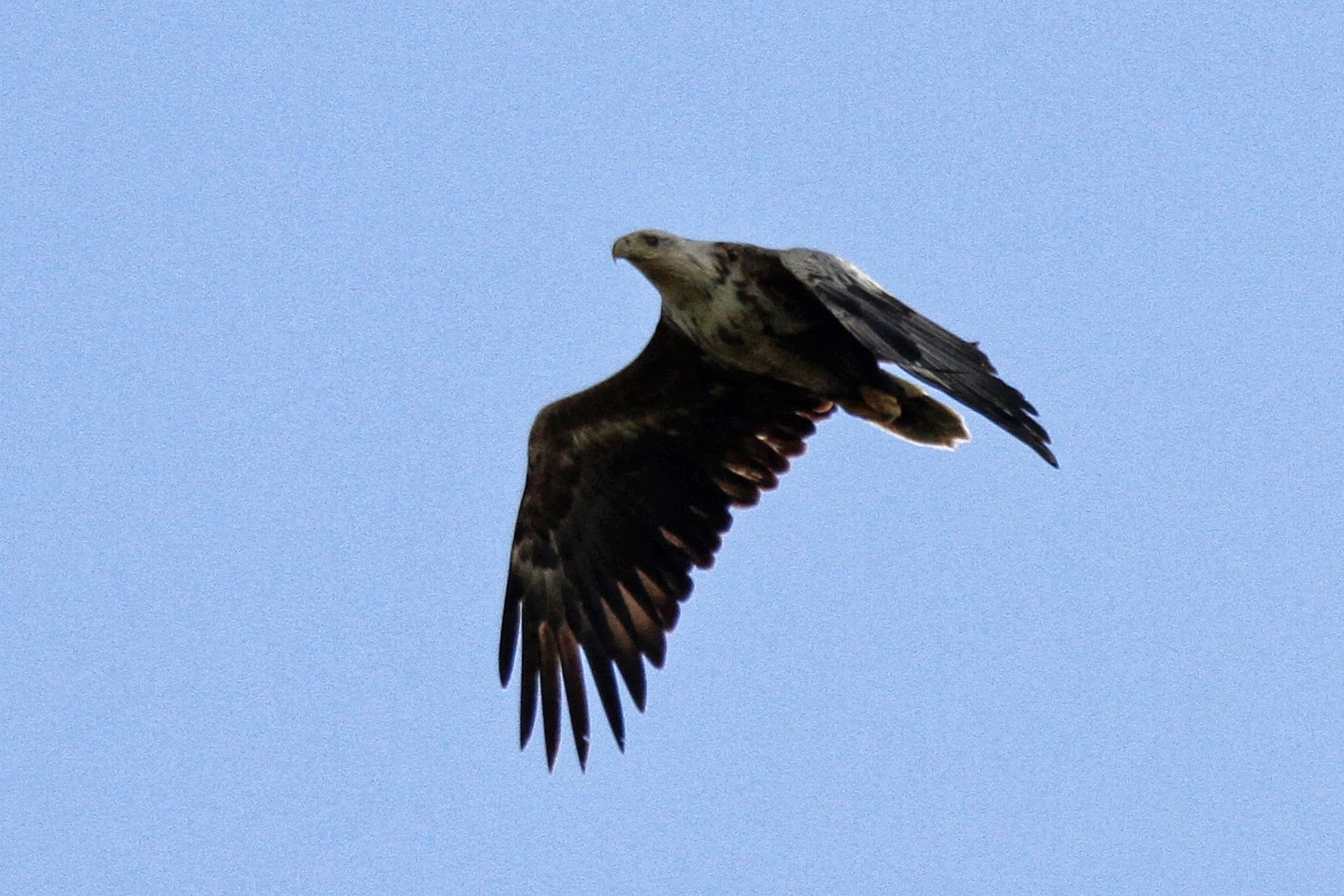
Our highlight as we were heading back to lunch was the first appearance of a white-tailed eagle that has been resident around St. Paul for the past 2 years.  Even though St. Paul Island is only 42 square miles in size, seeing the eagle is totally random because the guides do not know where it roosts.  When it is seen it has usually been on better weather days during the afternoon.  It is a beautiful bird, and was on every birder's wish list this week (all the rest of the photos in today's post were taken by Laura Keene--click on any photo to enlarge).

.
Our day had us visiting several of the key birding spots around the island, but the high winds had us back at our hotel by 8 PM which was still almost 2 hours before dark.  We were all settling in when Scott returned to pick us up to try to see a common rosefinch that he and Doug had found on the way back into town.  We all scurried around to get our gear back on, and quickly drove the short distance to where the bird had been sighted.  We all spread out on the hillside and tried to relocate it, but to no avail.  I did add 4 new trip birds for the day, and the eagle was life bird #6 for the trip for me.

Sunday turned out to be our best weather day yet--sunny with almost no wind.  We got off to a good start when we located 2 gray-tailed tattlers on Salt Lagoon.  Doug and Gavin helped us coral the flighty birds, and as they changed position on the rocky shore we listened for the distinct call of the gray-tailed tattler.


Next we tried again for the common rosefinch (life bird #7 for the trip for me) and luckily found it near where it had first been sighted.
 

Then we visited Polovina Hill where we had earlier seen the gray-streaked flycatcher.  It was still there, and while checking out the general area we had the white-tailed eagle come soaring by.


After lunch we visited Hutchinson Hill and the Webster Lake area, but found nothing new.  After dinner we went to the quarry to search for an eye-browed thrush (it looks similar to an American robin) that had been found earlier in the day by other birders.  We located it again, but unfortunately it remained in sight so briefly that only our 2 guides and 2 other birders in our group were able to see it before it flew back up into a rocky area.  We spent some time trying to get it to flush back toward the main group, but did not succeed.  The day generated 3 more trip birds for me.

On Monday the weather continued to be pretty good--overcast with some fog but little rain or wind.  We tried twice to find the eye-browed thrush but failed again.  We did see many of the rosy-crowned finches that are everywhere on the island.


We visited Marunich Point to do some seawatching where we had a fly by yellow-billed loon, and a pair of red-necked grebes plus a large raft of king eiders.  The bird of the day was found in a celery patch below Hutchinson Hill--an arctic warbler.  These last 3 were all new trip birds for me.


Tuesday (Day 10) in my opinion was the worst weather day so far.  It was chilly and raw with driving rain at times on high winds that made it not much fun to be out birding.  Because the winds were from the south and southeast, we did a fair amount of seawatching in hopes of finding something special like a mottled petrel or an albatross.  The best we could find was a sabine's gull, and either a long-tailed or parasitic jeager that still needs to have photos of it studied to confirm which one it was.  Both were new trip birds for me. I missed a parakeet auklet that flew by that would have made 3.

We were back at the hotel by 7 PM.  Tomorrow is the last day for many in our group who will be flying out in the afternoon provided bad weather does not prevent the plane from landing here.  7 of us including my friends Dan, Doreene and Laura will be staying on, and we will be joined by 9 new birders.  I still have 10 more days of birding here, and so far have seen a total of 80 bird species. The weather forecast for the next few days is for more favorable westerly winds that hopefully will bring us some more Asian vagrants.  Stay tuned!

Saturday, September 21, 2013

The Pribs--Days 4 to 6

Wifi service here at the King Eider Hotel is pretty erratic so I am going to do a fairly brief update for now.  The weather on Wednesday was more typical of the Pribs in the fall--mid 40's, windy, and spitting rain.  We did a seawatch again and my friend Laura got a nice shot of a slaty-backed gull.  We were able to see some short-tailed shearwaters, least auklets and ancient murrelets fly by the point.


We also got our first up close and personal look at a red-legged kittiwake (photo also taken by Laura--click on any photo to enlarge).  Other birds of interest for the day included an Aleutian cackling goose, a chipping sparrow and an American robin.


As the sign for St. Paul said in my last blog post, this island is the largest fur seal breeding location in the world.  In June the number of seals is on the order of 400,000, but in the fall there are many fewer still here.  That said, you still are amazed at the numbers that you encounter as you move around the island.  The seal pups are everywhere along the water's edge.


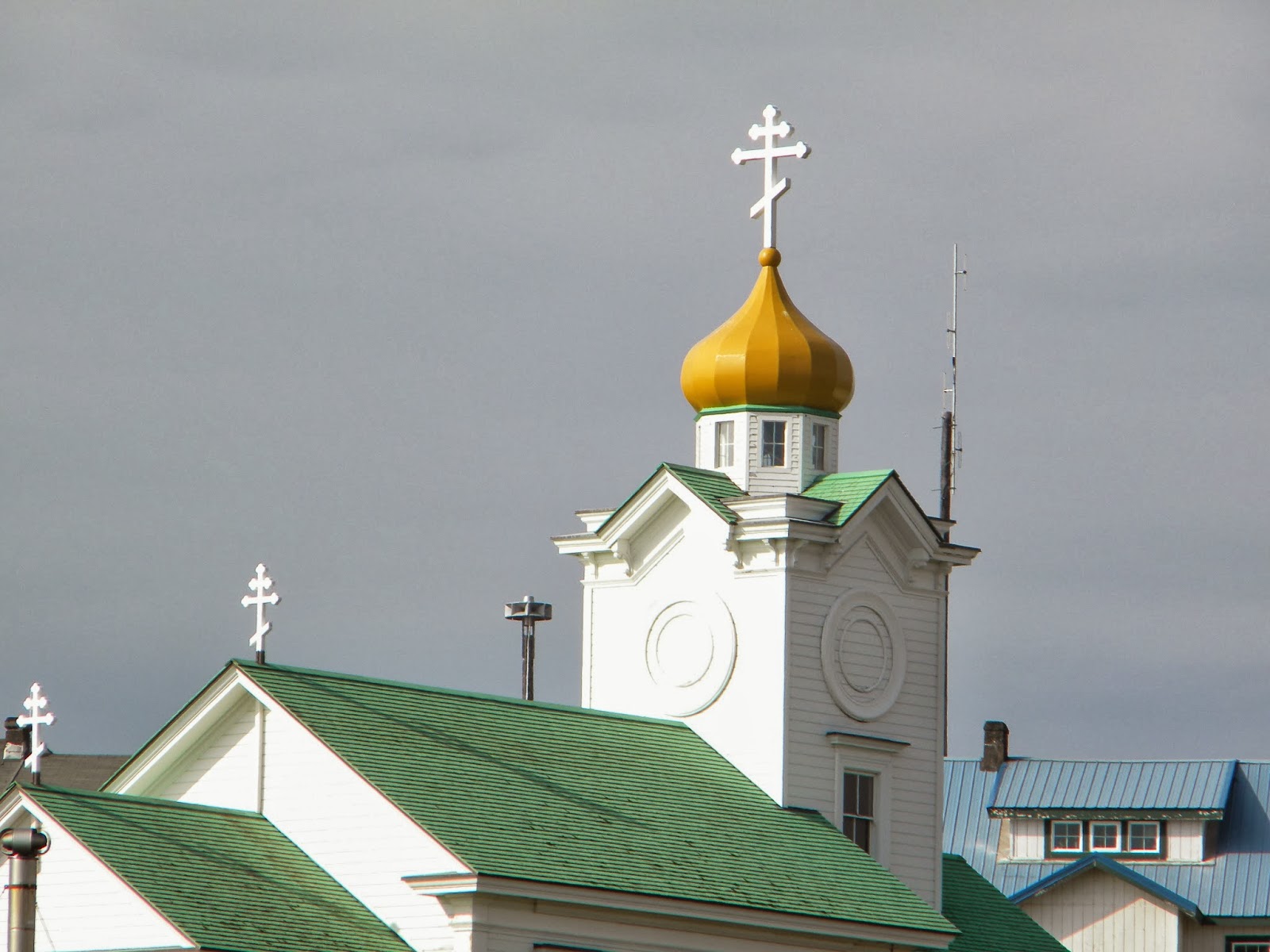
The rest of our birding group was supposed to arrive about 4 PM, but due to mechanical problems with the plane they did not get here until 7 PM.  We were just happy that they got here at all since it is common for weather to keep planes from landing here.  Like all new arrivals, they get to see the Russian Orthodox church as they drove into town.


On Thursday morning we all piled into the St. Paul Island Tour bus, and began a full day of birding after a hearty breakfast at the Trident canteen.  The weather was better than on Wednesday with no rain, not much wind and even some sun.  At the seawatch we had a peregrine falcon fly by.  We saw the red-necked stint again.  2 new birds in the morning were a eastern yellow wagtail, and an emperor goose.

After lunch we drove out to Polovina Hill, and discovered a streak-sided flycatcher which is a very nice Asian vagrant for the island.  The group also got to see a common snipe and a few sharp-tailed sandpipers.  After dinner we drove to the far northeast part of the island where the newly arrived birders were able to pick up a female brambling and the red-breasted nuthatch from prior days plus a red fox sparrow.


We stopped at Webster lake on the way back to walk the same celery patch that had produced the Middendorff's grasshopper sparrow last Monday.  We flushed a lincoln's sparrow which was the first ever seen by our guides on the island.  At the same time Gavin found a fork-tailed swift (also called a pacific swift) flying overhead.  Fortunately Laura was able to get a diagnostic shot of the bird showing its white rump.  This bird was not only a life bird for all of those in our group who saw it well enough to be able to count it, but was also a life bird for all 3 of our guides.

Today, Friday, was a brutal day weatherwise--driving rain with high winds.  As a result, while we tried to find some birds, we mostly got wet and cold.  No new birds were seen for the trip, and we stopped birding earlier than normal.  We are hoping the storm that passed over us today will bring some nice new birds on the west winds over the next couple of days. So far I have seen 68 different species on the island, and the flycatcher and swift were 2 more life birds for my ABA list. Stay tuned!

Wednesday, September 18, 2013

The Pribs--Days 1 to 3

I flew on Saturday the 14th to Anchorage where I met up with Laura Keene, a birding friend from Ohio.  The flight on Sunday from Anchorage out to St. Paul required us to stop at Dillingham to add more fuel, but also meant they were able to add a few more pieces of luggage to the overweight plane.  As a result my main bag arrived with me, but Laura's did not.  We were met by Scott Schuette and Doug Gochfeld, our guides for the trip.  Our 3rd guide, Gavin Bieber, was on the plane with us, and his luggage also had been bumped because of too much weight.  The sign on the way into town is very outdated--much closer to 300 different species of birds have now been recorded on the island.


We dropped our gear off at the duplex we would be staying at for the first 3 nights, and were introduced to the Trident seafood canteen where we would be eating our meals.  The food is nothing to write home about, but there is plenty of it with a range of choices that will more than fill up your plate.

After eating dinner,  Scott and Gavin took us out to bird until it got dark around 9:30.  We began the trip quite well, seeing 25 species including 2 bramblings, 2 common snipe and several red-legged kittiwakes mixed in with 100's of black-legged kittiwakes.  We went to sleep feeling very good about our first less than 1/2 day of birding on St. Paul.


We awoke on Monday morning to a mostly sunny day which is never to be expected at St. Paul.  Doug met us at 9 AM to begin our day.  We were treated to lots of horned puffins (photo above--click on any photo to enlarge) and a fair number of tufted puffins.  We also did some sea watching in hopes of finding some auklets for Laura's life list (photo below of Laura and Doug).  By this time of year the auklets have mostly left St. Paul, but we did see both common and thick-billed murres.


We walked town marsh and found 3 sharp-tailed sandpipers which are expected in the fall.  By the end of our first 3 days of birding we had the pleasure of seeing quite a few like the one below.


After lunch all of us walked a celery patch at Webster.  Much to our surprise and delight we flushed a Middendorff's grasshopper warbler--only the 2nd to ever be recorded on the island.  It took us awhile to relocate it, but we finally did which resulted in some pretty good photos like the one below taken by Laura. We could not believe our good fortune in finding an Asian rarity that certainly was not on our list of target birds for the trip.

After dinner we birded some other key spots and found a lesser sand plover, a warbling vireo and an American tree sparrow.  We headed back to the duplex with a stop to pick up Laura's luggage that had arrived on a cargo plane feeling pretty tired from our 10 hours of birding.  We added 20 more trip birds for the day.


Tuesday's weather was almost identical to Monday.  Scott picked us up at 9 AM, and we proceeded to visit some of the same places from the day before.  We added 10 new birds for the trip including a red-necked stint, a red-breasted nuthatch and a yellow-rumped warbler.  Tomorrow we will be joined by a large group of birders to begin an ABA sponsored week of birding.  Our friends Dan and Doreene will be arriving as part of the group.  After 3 days the trip list was up to 55 species, and the red-legged kittiwake, the common snipe and the Middendorff's grasshopper warbler were all life birds for me. Stay tuned!

Friday, September 13, 2013

The Pribs Are Calling

I am off to Alaska to spend almost 3 weeks on St. Paul Island in the Pribilofs which are in the Bering Sea north of the Aleutian Islands chain.  To get there you fly west from Anchorage on a small turbo-prop plane for 4 hours.  I have never been to the Pribs, and am very much looking forward to seeing what the fall winds and weather might bring in from Asia.  There is internet access, so I expect to be able to do a few blog posts while I am there.

Before heading out, I thought it would be good to do another 2013 big year update.  First, the numbers.  Neil Hayward had a good first week of September at Gambell, and made it back to Arizona to see the sinaloa wren.  Since he had nothing scheduled until 9/20 when he will hopefully be on a boat off the west coast, he has just returned to Gambell in hopes of finding more rare vagrants.  As of today his full ABA area big year total is 710 which is still on the pace that John Vanderpoel was on back in 2011.

When Neil was at Gambell he saw Ron Furnish.  Ron has not completed his travel report for that week at Gambell, but his tally for the year now stands at 665.  As both Neil and Ron were leaving Gambell, Jay Lehman arrived from Arizona via Nevada where he picked up the himalayan snowcock.  He also immediately had good fortune at Gambell picking up siberian accentor, yellow-browed warbler and stonechat (siberian race) which raised his big year total to 643.


So some of my readers may be curious as to how these 3 guys are doing relative to other recent big year efforts.  Specifically, could Neil set a new full ABA area big year record, and can Jay and Ron reach 700 species before the year is out?  In the case of Neil, since he has only about 10 more species that he should be able to see relatively easily, his chance to set a new big year record is dependent on how many code #3-5 birds show up over the next 109 days.  For Jay and Ron, they both have lots of code #1 and #2 birds not yet on their big year lists that they could still find, so they both could make it to 700 different species by the end of December.

In all 3 cases, seeing rare vagrants is still the critical unknown factor as to how their respective years finish out. Examining other big year efforts will give some context to this point.  In 2011, John Vanderpoel by this date had seen 711 species.  Over the rest of the year he saw another 32 new birds of which 23 were code #3-#5.  In 2010 by this date, Bob Ake had just reached 700 birds for the year.  By the end of 2010 he saw 31 more new birds of which 23 were code #3-#5. In 2008 by this date, Lynn Barber was at 679 species, and saw 44 more new birds of which 19 were code #3-#5.  Sandy Komito, the record holder at 748, had already seen 736 species by this date in 1998, and almost all the remaining 12 new birds he saw that year were code #3-#5.

These data points give you some idea of the probabilities involved vis a vis vagrants.  Some years are better than others for rarities, or specific vagrants as we have seen in 2013 with blue-footed boobies. Based on the most recent few big year efforts, it would appear that as many as 20 code #3-#5 birds could be seen by any or all of these guys over the remaining days of 2013.  We won't know until the clock strikes midnight on 12/31.
My photos for today are of a long billed curlew I saw in California in September of 2010 during my lower 48 big year, and of our new vizsla puppy that like all puppies is both a joy and tribulation (photo taken by my son Caleb).  So far this summer the Pribs have had some very good birds show up.  Here's hoping that keeps up while I am there.  Stay tuned!

Tuesday, August 20, 2013

The Hare Hits 700

No surprise given how hard Neil has been working in August, the Hare yesterday reached 700 bird species seen in the full ABA area when he visited Patagonia SP in Arizona to see an immature blue-footed booby.  He was on his way to New Mexico last week when the blue-footed booby found there was picked up to save it from starvation, so he was pretty happy at getting a second chance.  During my lower 48 big year in 2010 I was hoping that a blue-footed booby would show up but alas it did not.  You can get the full update of his birding since my last post about the hare and the tortoise at his blog site which is linked to mine.

It seems only fitting to provide a bit of perspective to Neil's effort so far.  For those who have been reading this blog lately, you already know that the record holder, Sandy Komito, reached 700 birds at the incredibly early date of July 12th back in 1998. and finished with 748.  John Vanderpoel in 2011 hit 700 birds on August 27th, and finished the year at 743 plus 1 provisional.  John's fall proved to be extremely successful.  By the time he reached 700 species, he had seen 45 code #3-#5 birds, and by the end of 2011 he saw another 35 of which 14 were seen in Alaska.  Neil saw 44 code #3-#5 birds on his way to 700, so he is on a pace that is consistent with John's in 2011.

Neil still has some pelagic trips to make, at least another trip to Alaska, and 10 likely to see code #1 and #2 birds to pick up.  It is impossible to predict just how many code #3-5 birds may show up over the next 4+ months, so all the big year watchers will be paying attention to see if Neil can break Sandy's record.


My photos are of the greater flamingos and a Wurdemann's heron that I saw in late August in Florida during my big year (click on any photo to enlarge).


Turning to the tortoise, Jay Lehman has not posted any updates since the 1st of August.  I have been informed that he has unfortunately had some major flooding problems at his home in Cincinnati which has kept him out of action.  I believe he has finally gotten the situation under control, and will soon be back out birding.

Finally, I mentioned in my last post that I had recently heard of another birder, Ron Furnish from Virginia, who began the year committed to adding to his full ABA area life list, and has now decided he is also doing a big year.  I received a comment on my last post telling me that he does have a blog on the whatbird.com site where you can read his trip reports which I have now done.  I have decided to call him the new guy because I only recently found out about him, and because he began the year with only 132 ABA area life birds.

His level of birding experience reminds me of another big year birder, James Vardaman, who was not really a birder at all.  Nevertheless, he decided back in 1979 to attempt a big year because he thought it would be a good marketing tool for his timber company.  He wrote a book about it afterward titled, "Call Collect, Ask for Birdman".  His year ended with 699 birds on his list which at the time became the record for the full ABA area.

Like James Vardaman, Ron has had the support of many good guides in his birding adventures to assist him in locating hard to find species.  One of those guides he used I also know from my big year, Wes Fritz.  We met first on one of Debi Shearwater's pelagic trips since he was the main chummer for her that year.  While I did essentially no birding with guides during my big year, Wes and I hit it off, and ended up doing some birding together in the fall to chase rarities in CA that he also wanted to see.  Wes is one of the more colorful birders that I have met over the years, and one of the best field birders that I know.  I always enjoyed our time birding together that year, and have seen him since in California when I have been out to do other pelagic trips.

In reading through Ron's trip reports, I noticed a couple of things that I think merit commenting on.  First, Ron is not counting heard birds as part of his list even though that is acceptable by the big year birding guidelines.  Given that he is a relatively new birder, this is probably a good decision since his field experience with bird calls and songs is limited.  In his blog he wonders at one point if anyone who has broken the 700 level has in fact seen at least 700 species.

I personally know 9 of the other 700+ big year birders.  In my case, I had 4 heard only birds on my lower 48 states big year list (black rail, boreal owl, Bicknell's thrush and himalayan snowcock), so I did see exactly 700 species plus the 4 heard only species.  I have not asked Sandy Komito (748), Bob Ake (731) or Lynn Barber (723) about heard only birds, but given how high their year totals were, I would be very surprised if they did not see at least 700 birds during their respective big years.  John Vanderpoel (743), Dan Sanders (715), Greg Miller (715) and Al Levantin (711) all have emailed me that they saw more than 700 species during their respective big years.  In fact, Al said that he had no heard only birds on his big year list. I do not know how many heard only birds Benton Basham (710) had in 1983.  That leaves John Spahr of those I personally know who emailed me that out of his total of 704 birds in 2010, he had at least 6 heard only birds, so he would be the only one that I know of the 700+ group who had less than 700 seen birds as opposed to both seen and/or heard.

At another point in Ron's blog he references a conversation he had in May with someone in Texas about the 12 birders who have seen and/or heard 700+ species in a calendar year.  This person claimed without naming the birder that one of the group was not legitimate.  Ron wrote in his blog that he was going to talk with Bob Ake about it.  I spoke with Bob after reading what Ron had written to see if Ron had done so.  Bob told me he had, and that he had told Ron that he had no doubts about the legitimacy of the 12 known 700+ birders.

I am raising this point because, like golf, birding is all about an honor system when it comes to bird lists.  Do people cheat in golf--yes.  Do people claim birds on their list that in fact they might not have seen and/or heard--yes.  But in both cases they hopefully are the rare exception.  Being a member of the 700+ group, and knowing what it takes to complete a big year, I find it troubling that a relatively new birder would publish in his blog something that might besmirch another birder, and then not follow up on his blog to clear up the allegation.  In this day when the internet is free to anyone to say anything that they want, and then what is written may remain in the ether for years to come, I feel that it is the responsibility of all bloggers to be sensitive to that reality, and to clear up anything that may be misleading, and in turn hurtful.

I am off to the Pribs in Alaska in mid Sept.  I will post again prior to that trip.  Stay tuned!

Thursday, August 1, 2013

Big Year 2013--the Tortoise and the Hare

It is August first and time to do another update on this year's full ABA area big year efforts.   I have decided to call it the year of the tortoise and the hare.  The tortoise is Jay Lehman because of his very slow start, and the hare is Neil Hayward because of his record pace so far.

Jay has spent the last 3 weeks in the northeast, North Carolina, Texas and California beginning to pick up the vast number of code #1 and #2 birds he still has to find for his big year.  He seems to be very focused on this task because he has not chased any of the rarities that have shown up in the lower 48 states in July, not even the 1st recorded sighting in the U.S. of a rufous-necked wood-rail.  You can read all the details on his blog which is linked to mine as is Neil's.  I just exchanged emails with Jay who told me he will soon be updating his blog, and has finished July at 580 birds for the year.  He will be birding in CA and AZ next.


Neil has continued on a torrid pace, picking up many of the remaining code #1 and #2 birds he still needed, but has also managed thru a ridiculous travel schedule to see several code #3 and #4 birds as well.  Neil's past couple of weeks reminds me of the right time/right place good fortune John Vanderpoel had during his big year in 2011. For example, Neil was in FL for a pelagic trip in hopes of getting a white-tailed tropicbird which he did not see, but a fork-tailed flycatcher was found near Orlando that he was able to see.  It disappeared the day after he saw it.  John had the same experience in seeing a fork-tailed flycatcher in FL in 2011.

Neil then flew back to CA even though he had just been there, and was able to see a lesser sand plover in San Diego before it departed the area.  He immediately went to AZ and was fortunate to find the extremely rare slate-throated redstart before bear activity closed the canyon it was in in the Huachuca Mountains near Sierra Vista.  He also had time to find a black-capped gnatcatcher.

He then went back to CA for a pelagic trip out of Half Moon Bay where he had a chance to meet Jay and Sandy Komito, and picked up 3 more year birds.  Then he had the good fortune that a little stint was found in King County that he saw also before it left.  He wrapped up July with a return to Madera Canyon in AZ to spend all day staking out some feeders to be able to see the rare berylline hummer that had just started appearing at Madera Kubo.  As a result he finished July at 696 total birds for his year.  On his blog back on July 2 he outlined his birding plans for the rest of 2013 which undoubtedly will take him well beyond the 700 level.  He is still on a pace that is just a bit ahead of the one John Vanderpoel set in 2011 when he almost eclipsed Sandy Komito's full ABA area big year record of 748.


I spoke with Bob Ake this week who had reached 684 total birds by July 31st in 2010 during his full ABA area big year.  He finished 2010 with a total of 731 birds.  Bob told me there is a man from VA relatively new to birding named Ron Furnish that he has been advising who is also doing a big year.  Bob did not think Ron was doing a blog so no one is aware of his effort.  Bob said Ron has recently passed 600 birds so far for the year.

I added the photo of the Santa Cruz Island jay and the spotted dove because these are both birds that I saw about this time during my lower 48 big year in 2010.  I know that Neil recently saw both these birds, and I assume Jay will be adding them to his list very soon as well.  Stay tuned!