Tuesday, August 14, 2012

July 2--Tarangire NP

Some more background on why we did this trip to E. Africa.  In my case, I had gone to Uganda in August of 1972 after graduating from college to work in a public health project.  Unfortunately, Idi Amin was the dictator at the time, and as my older readers may remember, he was killing quite a few people.  After 10 weeks of trying to get our project underway, including being arrested at one point and driven 3 hours back to Kampala in the back of an army jeep with 2 soldiers holding rifles, we finally had to abandon the project.

I had gotten a new camera before going to Uganda, but had waited to buy film there.  I was only being paid $80/mth, and when I found out how expensive film was in Uganda, I decided to have my girlfriend bring film when she came to join me.  Because of the problems in Uganda, she was never able to get a visa, and thus never arrived.  So I ended up with no pictures of my time there.  With the new age of digital cameras, this was not a problem this time around as I ended up taking over a 1000 pictures with my Nikon point and shoot, and Bob took over 10,000 with his much better telephoto lens.  I will always indicate which photos are his to confirm his copyright for 2012.

I also was not a birdwatcher back in 1972, so I have little memory of seeing birds while in Uganda.  Unlike our N. American birds, E. Africa's birds are generally much more colorful, and diverse.  The ABA area (N. America north of Mexico) has about 675 breeding birds, and a total of 970 different bird species have ever been recorded in an area covering 7.6 million sq. mi.  The countries of Tanzania, Kenya, Uganda and Rwanda have recorded almost 1400 different bird species in an area that is 1/10th the size of the United States and Canada.  When you consider my abbreviated visit 40 years ago, add in the wild animals, and the opportunity to go sit with a gorilla family, well I think you can see the allure of such a trip.


We had arrived at the Tarangire Safari Lodge in the dark, so we did not realize until the next morning what an awesome view we had looking out from the lodge area.  Sleeping in our big tents was most restful even though we heard lions growling nearby during the night.  Brian also heard an African scops owl calling.  Before eating breakfast, we checked out the bush behind our tents, and found a gray headed kingfisher (photo below), one of the many woodland kingfishers in E. Africa.


Over by the lodge we looked up in the sky to find 100's of alpine swifts zipping thru the air, with a a few African black swifts mixed in with them.  We also found an eastern violet backed sunbird (photo just below taken by Bob).  For me, the sunbird family, which numbers over 50 different species in E. Africa, and range is size from 3.5 to 6.5 inches, is like a cross between our hummers and wood warblers.  We saw at least one species of sunbird, and often several, each day of our trip.


While eating a buffet breakfast with an omelet station, we saw the Spanish family wander in, bleary eyed from staying up late to watch Spain crush Italy 4-0.  The Spanish soccer team has now won the EUFA championship in both 2008 and 2012, and in between won the World Cup in 2010.  It is now considered one of the great sports dynasties.  Needless to say, the Spanish family was thrilled to have won.


We loaded up our landcruiser, and headed out for a long day of bird and animal watching.  The landcruiser has a pop up top so that as you slowly drive the very dusty dirt roads in the park, you can stand up and look out taking in the full scene.  For a good part of the day we were near the river that runs thru the preserve, and at one point we found a hamerkop apparently taking advantage of the banded mongoose group stirring up the water which scared food out for the bird (photo above taken by Bob)


At another point along the river we found a pair of saddle billed storks hiding in the reeds (photo above taken by Bob)--what an amazing bird visually!  Our first owl sighting of the trip was the pearl spotted owlet (photo below).  We found a second one later in the day. 


Mid morning we came across our first sighting of a lioness whose red face meant she had just been feasting on a kill that we could not see from our vehicle.  Because of the wild game, when you are in the national parks, you have to stay in your vehicle at all times other than to jump out to take a quick piss.


One of the bird families that I found quite interesting is the mousebirds of which we saw 3 of the 4 species that reside in E. Africa.  You almost always see them in small groups like the blue-napeds in the photo just below.


As we were driving down to the park the day before, we saw gray crowned cranes perched in a distant tree, so we were pleased to be able to see a pair much closer feeding on the ground while touring Tarangire (photo taken by Bob).  This is E. Africa's main resident crane.  Also, like on day 1, we saw quite a few chestnut-bellied, yellow-throated and black-faced sandgrouse usually flying over us as we drove along.


We were constantly on the look out for birds hiding down in the grass.  We saw 4 different members of the francolin family at Tarangire, including the yellow-necked (photo just below) and red necked spurfowl, and the coqui and crested francolins.


The are many birds of prey in E. Africa--eagles, hawk eagles, snake eagles, kites, kestrels, falcons, harriers, hawks, goshawks, sparrowhawks, buzzards, and vultures.  During our trip, we saw many fish eagles which are similar to our bald eagle.


One of the most unusual bird families in E. Africa is the hornbills.  We saw many different species including at Tarangire African gray, red-billed, Von der Decken's and southern ground-hornbill (photo just below taken by Bob).  These are large birds that seemingly have few enemies to threaten them.  They all have huge curved bills--thus the name hornbill--with the males' bills being often twice the size of the females'.


As we traversed the park, we crossed paths with many common zebras who are related to donkeys.  In the photo below (taken by Bob), you can see several wattled starlings standing on the zebra's back.  It is very common to see birds perched on zebras, giraffes, cape buffalo, rhinos, and a large number of different ungulates, eating whatever bugs they can find on the skin.


E. Africa does not have anywhere near the number of parrots that S. America, or New Guinea and Australia have, but they have a few like the orange-bellied parrot (photo taken by Bob).


Each day of our trip we would have a box lunch prepared by the lodge/hotel we were staying at.  We would either eat lunch while driving to our next destination, or stop to watch birds while eating.  We usually ate breakfast anytime between 6:30 and 7:30, and lunch would happen as early as 12:30 and as late as 2:30 depending on the birding.  By the second day of the trip, we already began to sense that our box lunch was never going to be very appealing.  As the blog proceeds, I will provide more details.  At Tarangire we stopped at a small water hole where many small birds were coming in for a drink including a green winged pytilia (photo taken by Bob).


Our time in Tarangire seemed to fly by, and before we knew it we needed to begin driving back north to Arusha to spend the night.  On our way out we did see a mother elephant with 2 offspring taking a dust bath after having taken a mud bath.  We saw elephants often on our trip, but like all the big game in E. Africa, you never get tired of spending time near them in their natural habitat.


The drive back to Arusha was bumpy and seemingly endless, especially when we hit rush hour traffic in town.  While in E. Africa I took very few pictures of the people and town scenes because I did not want to "intrude" on their lives.  Plus, the masai, which are the dominant people of NE Tanzania, and much of Kenya, will not let you take their picture without paying them.  So I will instead describe images that have stuck with me.  One of them is the mini-vans that serve as taxi's all over E. Africa.  These are specially modified to seat 12-15 passengers, and they are always full!  They are everywhere in the towns and cities, and you also see them driving between towns and villages.

Fortunately, our driver, Abdul, knew Arusha well, and he took us on a very bumpy back road to avoid the traffic.  We arrived at our lodging, the Korona Hotel, about 8:30.  The rooms were pretty nice, and the dinner we would discover in hindsight was better than many we would have.  We met a young woman who was in Arusha on a Fullbright scholarship to observe the work of the Rwanda genocide tribunal that is based in Arusha.  After such a long day, we were very ready to hit the sack.  Stay tuned!

Monday, August 13, 2012

Here We Go--July 1

This trip of a life time was organized by Bob Wallace who I first met birding at Gambell, AK in May of 2006.  I ran into him again in April of 2010 during my lower 48 big year while looking for a bar tailed godwit in the Everglades.  He and his friend, Dex, became champions of my big year, encouraging me to go all out, and helping me in September to see the Cuban pewee that showed up in the Everglades by picking me up at the Miami airport on their way to see the bird.

He got the idea of the trip from a birder he knows, Luddy Lamberton, who did essentially our same trip with Ron Hoff and Dollyann Myers, using Brian Finch as their guide.  The main difference was that they did their birding mega-tour of E. Africa in February 2011 when they could also see many palearctic birds that we would not be able to see by doing our trip in July.  As a result, they saw over 900 bird species!  Using their trip as a reference point, we set a goal of seeing at least 700 bird species with the hope that we could even get over 800.  By the end of this series of posts on our trip you will know what our final total ended up being.

We began working on the details of our trip in December of last year.  In hindsight, we would recommend that anyone putting together a private birding trip like ours start on it 12 months in advance to insure you are able to get exactly the trip you desire.  This is particularly true if you want to have a gorilla trekking day as part of your itinerary since getting the trekking permit can be difficult.  Enough background for now.


I flew over night on AA from Raleigh/Durham to London, Heathrow on Friday June 29th.  I met Stu Wilson for the first time at the airport.  I had a light breakfast at Wagamama's while beginning to get to know him.  Bob arrived a couple of hours later.  We all flew on BA to Nairobi, arriving about 9 PM, which was less than 24 hours after leaving North Carolina.  We were in our hotel and asleep before midnight.

We were up early to eat the buffet breakfast which was quite extensive and included an omelet station.  We were all surprised how "white" our omelets were when they arrived at the table.  We discovered that African chicken eggs have very light yolks so the omelets and scrambled eggs look like they are made from egg whites only.

Brian Finch, our guide, joined us about 7 AM, and we all went outside the hotel to see what birds were around while waiting for some info to be delivered to Brian from our trip ground agent.  One of the highlights was the sunbird nest (photo above--click on any photo to enlarge) with a female bronze sunbird sitting in it.  We birded for about 30 minutes before getting into the Toyota landcruiser, and ticked over 20 species for the trip just on the hotel grounds.


Our day was spent driving from Nairobi to Tarangire National Park in northeast Tanzania, a distance of about 400 KM (250 miles).  The roads were mostly paved, but not up to the standards we have here in the U.S.  Brian was riding shotgun and occasionally he would ask our driver (Peter in Kenya and Abdul in Tanzania) to stop for birds like the Hartlaub's bustard above (photo by Bob Wallace), and the augur buzzard below.


After about 2 hours of driving we came to the Tanzania border where we had to fill out exit visas for leaving Kenya.  They also have electronic machines to record your finger and thumb prints as well as a camera to take your picture.  You then drive down the road 100 yards to the Tanzania border control, and fill out visa entry forms where they repeat the process.  This is where we changed vehicles and drivers also.


After getting thru the border crossing, we continued on our way, again stopping randomly to record new bird species like the paradise whydah and white-headed buffalo weavers just above, and the scarlet-chested sunbird below, both photos taken by Bob.


Our main goal for the afternoon was to get to a grassy area that has several species of lark, including the very rare Beesley's lark, a Tanzanian endemic.  Once arriving at the appropriate habitat (photo above of Stu and our landcruiser), we found rufous naped, red capped and athi short-toed larks, and Fischer's sparrow-larks.  After some tromping thru the brushy/grassy habitat we finally flushed 2 of the Beesley's (photo just below, taken by Bob).


We would have continued to look for other lark species, but once we found the Beesley's we needed to keep driving to make sure we made it to Tarangire NP before they closed the gates at 6:30.


Like many other tour groups, we all came rushing down the 8 KM of dirt road that takes you to the park entrance.  While our driver, Abdul, got us checked in, we were able to do some birding around the parking area.  In addition to seeing several new species like slate-colored boo bou and African orange bellied parrots, we also enjoyed the yellow collared lovebirds (photo above, taken by Bob) that were flying around.

Once all the paperwork was completed we had time to bird a bit more as we drove into the park to our lodge.  As the sun was setting we began to see some of the animals in the park including a family of masai giraffes.  It had been a very long day of travel, chock full of new images and bird species, that kept all of us exclaiming how amazing it all was.


We arrived at the lodge just at dusk where we were taken to our tents with full bathrooms to deposit our gear.  We headed to the bar and dining area about 8 PM to try the local beers--Safari, Serengeti, Kilimanjaro and Tusker.  Dinner was soup, salad, a choice of 3 entrees and dessert.  Nothing stood out as being particularly tasty, but it was all edible.  A Spanish family was staying at the lodge, and they were all fired up about watching their soccer team play the Italians in the EUFA championship.  The game was not due to begin until 11 PM, so we all headed for our tents to get some much needed sleep after going thru the list of birds seen for the day.  This became a daily ritual either just before or after dinner.  After day 1 we had seen over 120 different species of birds.  Stay tuned!

Monday, August 6, 2012

Back Home After the Trip of a Lifetime

I am back home!  Wow what a trip I had birding in Tanzania, Kenya, Uganda and Rwanda from July 1st thru August 1st.  I was joined by Bob Wallace, the trip organizer, and Stu Wilson. Our bird guide for the entire trip was Brian Finch, a Kenyan citizen who is an amazing story in and unto himself.  I am still getting my body's time clock adjusted--7 hour time difference--plus I came home with a sinus infection from inhaling so much dust every day.


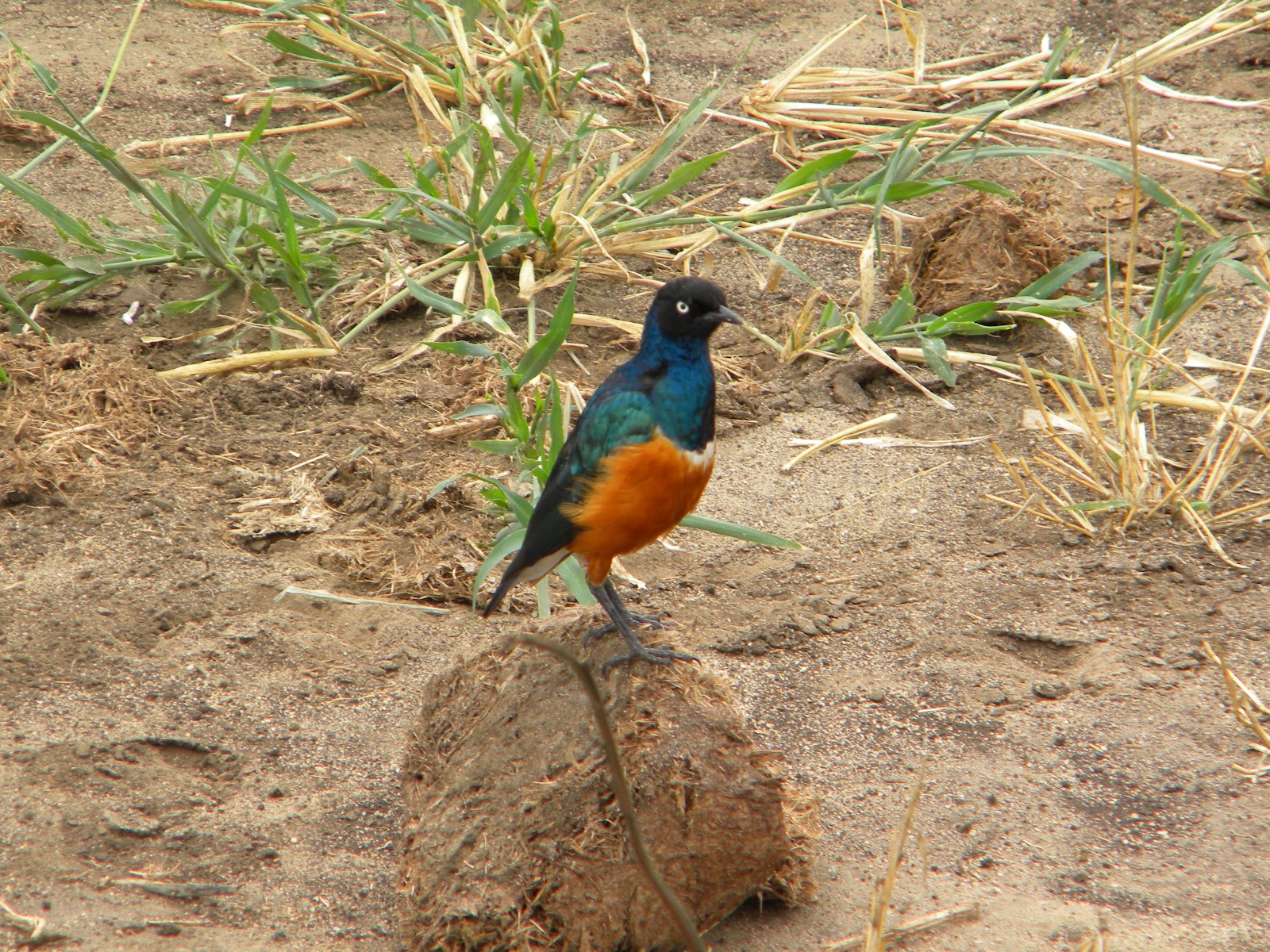
The superb starling in the photo above was one of the almost daily birds for us (you can click on any photo to enlarge).  I don't know how many times we wished out loud that the starling imported to the U.S. was as beautiful to look at!  And daily we saw birds equally or even more stunning visually. The number of birds seen was totally mind boggling, but you will need to follow the blog as I write it to get the final species count, or skip to the end sometime in September when I finish the story. 


We also saw many of the most desired big game as we visited several parks.  Elephants graced us on our second day of the trip, and were seen many times.  While our mammal count was no where near the final bird count, we did see many unique African animals.

My plan is to use both my photos and some of Bob's to provide color to my narrative.  It will be a few days until he can begin to send me some of the 10,000 photos he took.  Once that photo stream begins to come my way, I will be writing about each day of the trip, sharing the birds, animals and events  that stood out for me.  We birded all day on 31 days of our trip, with the only non birding day being the gorilla trekking day.  I am looking forward to the next several weeks of detailing this trip of a life time.  Stay tuned!

Friday, June 29, 2012

Can You Say East Africa!

This evening I will be flying to London, and tomorrow morning onto Nairobi, Kenya.  I will be meeting 2 other American birders in London, and we will be spending the next 4+ weeks watching birds, viewing wild animals, and for one day near the end of July we will be trekking in to sit with the gorillas in Rwanda.

I have done some birding outside North America--Hawaii, Great Britain, Italy, Morocco, Peru and Mexico, but nothing like this trip.  We will have a guide, Brian Finch, who is considered one of the best birders in East Africa.  We will be birding everyday for the entire month of July.  Our itinerary takes us to Tanzania, Kenya, Uganda and Rwanda.  This birding trip is generally done in Jan or Feb, or April or May, but the 3 of us decided to go in July instead.  This means there will be few migrating birds, but based on past trips, we expect to see over 700 different species of birds, and maybe over 800!  Having never birded in East Africa, these will probably all be life birds for me.  Even more amazing is that I could see more different species in a month than I did in all of 2010 during my lower 48 big year.

I will not be able to blog while on this trip, but I will be keeping a daily written journal plus taking pictures.  When I return in early August, I will be doing many posts throughout the month about all that transpired on this trip of a lifetime.  Stay tuned!

Tuesday, May 29, 2012

Graduation Road Trip and 2012 Big Year Review

I am back in Columbia, MO today having driven down from Northfield, MN yesterday.  My wife and I left last Thursday to make the 2 day drive to Northfield to attend our daughter Jess' graduation from St. Olaf College.  Graduation day was unusually hot--92 degrees--for Minnesota, and the graduates, professors, friends and family all suffered under the afternoon sun. 


After recovering from the heat, we drove into Minneapolis to have a celebratory dinner with Jess at 112 Eatery--a really good restaurant that we discovered 2 years ago during my big year.  It has one of those menus that makes it almost impossible to decide which dishes to order.  The duck with radicchio salad (above), and the razor clams with hearts of palm (below) were both superb.  We also loved the blue prawns with rooster mayo, the grilled asparagus with lardo, the pan-fried gnocchi with parmesan, and the sea scallops with oyster mushrooms.  The wines by the glass were not as interesting as the food--sauvignon blanc from New Zealand and verdejo from Spain.


My wife flew home yesterday, and Jess and I drove the 500 miles to Columbia to visit today with friends and family before continuing our road trip back to Chapel Hill, NC.  This morning my friend Marty and I went birding at a fine conservation area near here called Eagle Bluffs.  When we visited the area during the first week of May we were pretty well skunked as far as birds that day because of the very high water levels.  Today was almost the opposite as far as water levels which meant that we were able to see, and actually study close at hand some late migrating shorebirds including semi-palmated, white-rumped, and pectoral sandpipers.  The best "bird" of the day was 2 sandhill cranes (I did not have my camera but the photo below is of a sandhill crane I had seen last year--click on any photo to enlarge).


Since it is almost the end of May, which is also pretty much the end of the spring migration, I want to reflect on this year's big year efforts that I have been following thru the various blogs listed on the NARBA home page. For starters there are 2 "junior big years" being undertaken by 2 young birders who live in Colorado.  They seem to be having fun and getting out a fair amount.

I have enjoyed following Sara and Simon who are a trucking couple that are birding as they deliver their cargo around the country.  Their YTD is at 288.  Blake and Holly Wright are currently in Arizona as part of their photographic big year, and have seen 345 species YTD.  Then there is the father and son team, Eddie and Liam Ehrman from Ohio, who have covered a lot of ground including one spring trip to AK in April.  Their year to date count has reached 367 birds.

Next up is John Hargrove whose blog is being written by his wife Beverly. He has been in Alaska for the past 2 weeks birding at Attu and Adak with the Z tours group led by John Puschock.  He is now headed to Gambell with a Wings group.  He has hit 500 birds YTD, and Beverly says he is shooting for the full ABA area big year target of at least 700 species.

And finally there is the low budget big year effort of Renee Rubin and Michael Delesantro.  They have a budget of only $10,000, and are only driving around in their Toyota Prius.  They have spent a little more than half of their budget, but have already seen 586 different bird species.  In their most recent post (Slow Birding (apologies to Chris Hitt)), they have asked for assistance with an upper midwest trip in June to find a good list of birds that they still need.

Here is what I would suggest they do.  I assume that they subscribe to NARBA to get info on mega rarities.  They also should be daily checking birdingonthe.net to get up to date info most easily on recent bird sightings.  As for their routing, drive thru St. Louis, MO on their way north to pick up the Eurasian tree sparrow.  They also might try to contact Edge Wade in Columbia, MO who is a very good birder.  She might be able to help them find a Mississippi kite.

After MO, next up is Michigan to bird near Mio and Grayling to see the Kirtland's warbler on its breeding ground.  After that head to the UP to pick up American woodcock, black-billed cuckoo, spruce grouse, winter wren, boreal chickadee, least flycatcher, gray jay, and CT and Mourning warblers (the ABA Michigan bird guide is a very good source for finding birds in MI).  If they miss any of these birds in the UP, then they can keep looking in northern WI and northern MN above Duluth.  At Sax-Zim bog and Aitkin County they can also find CT warbler plus leconte's sparrow; willow, alder and yellow-bellied flycatchers; ruffed grouse, black-backed and northern 3 toed woodpeckers. Great gray owl and even northern hawk owl are also possible.  For assistance in MN they might contact Kim Eckert, and definitely use his bird guide.

From MN they should head into North Dakota to find Baird's sparrow, sharp-tailed grouse and gray partridge.  Next stop is Colorado to see black billed magpies, dusky, greater and lesser sage grouse, greater prairie chicken, and white-tailed ptarmigan.  If they missed northern 3 toed woodpecker in MN, they can pick it up in CO plus boreal owl, and possibly evening grosbeak and Lewis' woodpecker.  John Vanderpoel who did his big year in 2011 could be of assistance with all of these birds. Finally, another place to look for Mississippi kites is in Kansas on their way back to Texas.

In their last post they were pleased with their YTD total, but not surprisingly were seeing a definite slowdown in adding to the list.  I had seen 605 birds by the end of May in 2010, and only saw another 99 birds over the next 7 months.  Once they finish their upper midwest swing, things will really slow down for them.  They said they had originally expected to see between 600 and 625 birds given their low budget limitation.  I think they can get to as high as 650 depending on how many more rarities show up in south Texas where they live, and how they apply the remaining dollars in their budget.  No matter what number they end up with, they will definitely end up spending less per bird seen than anyone who has done a big year other than Kenn Kaufmann when as a teenager he hitch hiked all over the U.S. doing his big year.

I will be driving home over the next 2 days, and then will be there for the month of June.  My next birding adventure will be when I leave on June 29th to spend the month of July birding in East Africa.  More about this in my next post.  Stay tuned!

Monday, May 14, 2012

Magee Marsh--Wrap Up of 9 Day Stay

On Friday morning we were up even earlier than normal so that we would be at the Ottawa NWR visitor center before 7 AM to catch the tour bus to go to Cedar Point.  This is a part of the refuge that is usually not open to the public because of the stipulations of the grantor who gave the land to the Fish and Wildlife Service.  Dan and Doreene who have been coming up to Magee for over 20 years had never been able to tour Cedar Point, and all on the bus were not disappointed in what we found.


It was a chilly but sunny morning as we drove thru the entry gate, and we immediately were finding birds along the wooded gravel road.  Much to our surprise, we found the common nighthawk in the photo above (click on any photo to enlarge).  We would get out and walk a bit, then ride for a bit.  It took us about 3+ hours to cover 5 miles of really great habitat.  The roadway was bordered on the north by Lake Erie, and on the south side were the various impoundments.  Most of the roadway was lined by trees and shrubs.  We found several small groups of actively feeding birds including several warbler species like the black and white below.


After leaving Cedar Point, we stopped by Meinke marina and found 2 male bobolinks perched on a telephone wire.  While watching them we got a report of a black rail being seen again nearby at Metzger Marsh.  This was the 3rd sighting of this bird over the past week, so we decided to swing by the location to check it out.  The bird was seen by Greg Miller's cousin, uncle and nephew, so we were able to talk with them about it when we found them at the marsh.  Unfortunately, we did not have their luck in having the rail walk up out of the marsh to say hi to us.

We returned to the boardwalk after eating lunch at the Ottawa visitor center.  The bird activity was very slow but their were more birders arriving for a big weekend of birding.  We decided to go for an early dinner, and then returned to Metzger to look for American and least bitterns after 7 PM.  We traipsed out into the marsh on a beautiful spring evening but had no luck rustling up either bird.  We did flush several Wilson's snipe.  Since Rob had heard an American bittern calling at another location nearby when we had stopped to look for yellow-headed blackbirds, we went back for all of us to look and listen for it.  Once we heard its distinctive call, we headed back to our motel as the sun was setting.


As predicted, the winds had changed to the SW on Friday, and continued to blow from that direction into Saturday.  We hit the board walk about 7 AM, and by 8 migrating birds began to drop into the foliage.  At one point we found 12 warblers feeding in one small tree.  At another location there were well over 10 Swainson's thrushes gleaning in the leaves of a large cottonwood.  There were many black-billed cuckoos and a couple of yellow-billed cuckoos being seen along the boardwalk.  An acadian flycatcher was a rare find for Magee. A mourning warbler would be briefly seen before disappearing again for several minutes.  At the same place the huge moth in the photo above was seen for several days.  I also ran into Aaron and Ethan Gyllenhall, the brothers who had found the elaenia near Chicago in April.

Mid morning word began to get around that 3 young Amish boys had located a female Kirtland's warbler on the new trail at the western end of the marsh.  As on Wed., huge numbers of birders vacated the boardwalk and rushed to try to see the warbler.  I watched it feed in the top of a medium sized willow tree for several minutes before it flew further down the shrub line. 

Soon after seeing the Kirtland's, I needed to begin my drive back to North Carolina.  I heard later from my friends that the Kirtland's was seen off and on throughout the day, as was the mourning.  A golden-winged warbler also was found on the boardwalk.  I ended the day with 23 warbler species for only 5 hours of birding.  My 17 days of birding in NC, MO, KS, IN, and OH had generated 218 different species, and during my 9 days at Magee Marsh I saw 164 different species.  I am back home for 10 days before driving up to Minnesota to attend my daughter's college graduation.  I may do some birding in NC during June.  Stay tuned!

Sunday, May 13, 2012

Magee Marsh--Kirtland's Deja Vu


After posting my entry last Wed. morning, I headed over to Magee to see what might be around.  As I drove up to the parking area at the east end I saw a large crowd of birders intensely focused on the top of a huge cottonwood tree.  I parked quickly and jogged over to see what bird was creating such a commotion.  To my amazement and delight, having just missed seeing one 2 days ago, I discovered it was a male Kirtland's warbler.  I proceeded to watch for the next 10-15  minutes as it moved along the branches and trunk of the tree, often out of sight behind the leaves.  Unlike the bird shown below (photo by Adrian Binns) that entertained 100's of birders while feeding at ground level on the beach just east of this location back in 2010, this bird was a good 50 feet up in the air.  As you might imagine, there was great excitement with high fiving and jubilation in the crowd.


Unfortunately Dan and Doreene were still leading a tour group, and missed the bird because it disappeared some time after 9:30 AM. I moved my truck further into the parking area, and snapped another vanity plate of a birding friend, Ann Oliver, to add to my plate collection.


Later that afternoon Rob and Ricki arrived, and the five of us birded the boardwalk which was still very "quiet" birdwise for Magee.  There was still pretty good diversity, but the numbers were way down from my normal experience of birding there.  This was partly a result of the wind blowing in from the north rather than the south.  That said, I still found a total of 22 warbler species, which was my highest count for a day so far this trip.  I also was pleased to see the fox snake crawling out of the dead tree stump into the leaves of the adjacent shrubs to sun itself (click on any photo to enlarge).


On Thursday we decided to check out some other nearby birding sites to see what else we might find since the boardwalk would be pretty slow with the wind still blowing from the north.  We headed over to Camp Sabroske to check on the western sandpiper that had been reported from there.  On the way in we met another birder, Tom Camp, from Columbus who Dan and Doreene knew.  We all walked far enough around one of the impoundments to be able to get good looks thru our scopes of a small shorebird with a damaged wing.

Like other birders who had seen it since it was originally reported, our first thought was that this was a western sandpiper.  But then as it began to move around allowing us to study it, Tom suggested that maybe it was not a western sandpiper.  So we continued to examine its features. The bill was too long, and the bird was too big overall to be a western.  It ate like a dunlin of which there were several also in the impoundment area.  Finally, we could see a few feathers starting to form part of the distinctive black patch found on the belly of all breeding plumage dunlins.  We left to do other birding, but contacted another birder we knew to go over and take some photos of this bird.  He did and later let us know that we were right about it being a dunlin that had just begun its breeding molt cycle.

We finished the day celebrating Dan's 69th birthday at Danny Boy's restaurant in Sandusky.  We were looking forward to Friday morning's birding when we were going on a tour of Cedar Point, a part of Ottawa NWR that is not open to the public but was being made available as part of the Biggest Week in Birding".  Stay tuned!