We woke up to an overcast morning at Amani, and still had no electricity. We did not have waves of silvery cheeked hornbills either. Breakfast was a repeat of the day before. After birding a bit around the lodge, we began our drive to Tanga which is on the coast of Tanzania, and has a small airport where we would catch our flight over to Pemba Island. We had a not very birdy morning enroute to Tanga, so I have added the photo below taken by Bob of a gray cuckoo-shrike from day 6. We did stop at one point to look for a Kurrichane thrush. We heard one calling in a very tall tree. We kept looking and looking, but could not pick it up. Three locals came up to see what we were doing, and tried to help us find it, but they did not speak any english. After about 10 minutes, one threw a rock up into the tree, and the thrush flew out the other side and up the hillside.
We arrived a bit early for our flight to Pemba, and then the plane was also late arriving at Tanga. We said good bye to Abdul who had done such a good job of driving us while we were in Tanzania. The airport security was not your typical post 9/11 experience. They opened our checked bags to do a fairly perfunctory search. Our carry-ons were also searched, and they ran a wand over our body instead of having us walk thru a scanner. We were allowed to carry on water.
Our flight to Pemba Island only took 45 minutes in a 12 seat prop plane piloted by an African who appeared to be in his mid 20's and had trained in the U. S. He was very competent, and answered our questions about himself and the plane. We arrived at the island, which is just north of Zanzibar, a little after 5 PM where Yusef picked us up with enough time to make the drive to the Ngezi forest before dusk.
Our target Pemba Island endemic was the local scops owl. We spent about an hour just after dark walking along a sandy road listening to several Pemba scops owls calling, but were unable to locate one that we could shine our flashlights on. About 8 PM they stopped calling so we packed up and headed to our lodging for the nite. We arrived at the New Sharouk guesthouse after a somewhat unnerving ride along gravel roads without any streetlights while zipping by people walking or riding their bikes.
The meal at the guest house was one of our better dinners--grilled local fish, meat samosas, potatoes, and sauteed spinach. We also were introduced to bongo juice which is made from a local fruit grown on Pemba. It was quite delicious, and hard to describe--a unique taste. The guest house had internet access, so I was able to send my wife an email for the first time on our trip. We did our bird list update, and then were very ready to hit the sack.
We awoke to a sunny morning that felt warmer and more humid than any day so far, but then we were on an island in the Indian Ocean! After another routine breakfast, we walked out to be greeted by house crows, and then drove a a few blocks away to check out the Pemba flying fox bat day roost (click on any photo to enlarge).
We then proceeded to drive an hour back to the Ngezi forest to bird there for the morning. As we drove in the daylight, we really began to get a different feel for the culture of the island. There were definitely more muslims living there, and we saw a few women who were totally covered except for a small eye slit. It made them seem very mysterious.
On the way to the forest we saw a few Pemba green pigeons, another one of the island endemics. We also saw more of the Dickinson's kestrel (photo below taken by Bob) that is also an endemic.
Once we got back to the forest, we were able to get out of our vehicle and walk around the edge of the forest. We saw several crowned hornbills (photo taken by Bob). We also saw some water birds like great egrets, striated, black-headed and gray herons, little grebes, hamerkops, white-faced whistling ducks, egyptian geese, and hadada and sacred ibis.
As we worked the area we found a tambourine dove just above, and lots of madagascar bee-eaters which is another one of E. Africa's very colorful bird families (both photos taken by Bob).
Another island endemic is the Pemba sunbird of which we were able to see several (photo taken by Bob).
We walked along the edge of a rubber tree plantation where a African harrier hawk very cooperatively perched for us to take its picture (photo taken by Bob). Below is a photo of Stu pulling Bob loose from where his finger was stuck to the rubber tree sap.
We found often during our trip vervet monkeys which can be pests, and are called vermin monkeys by the locals.
Some other new bird species for our trip that we saw on Pemba included brown-headed parrot, broad billed roller, the endemic Pemba white-eye, southern gray-headed sparrow, and the java sparrow just below (photo taken by Bob).
After a productive morning of birding, we headed to the airport to catch our mid afternoon flight back to the mainland. While waiting at the airport, we ate our box lunch which included more bongo juice and meat samosas which were much better than our usual 3 day old grilled chicken. Security was pretty much like at Tanga, and we had the same pilot as the day before.
When we arrived at Tanga, we were picked up by John who would be our driver for the next 2+ weeks. We proceeded to the Kenya border, going thru the same exit and entry process. Unfortunately, a large bus arrived at the border control just before us, so we ended up having to wait in line for almost an hour. We were also concerned about our visa because it said single journey instead of multiple entry, but it proved to not be a problem.
We left the border about 6 PM, and our last new bird of the day was a Bohm's spinetail which flies like a bat. The drive to Malindi, our night's destination, took us thru Mombasa which we reached about 8:30. The traffic was horrible, and the short ferry ride was backed up so far that it took us 90 minutes of crawling along before we could board the ferry. All along the road side as we were passing thru Mombasa were small fires where people were cooking food to sell for dinner. The crowds were thick as were the bicycles, motor bikes, and mini-buses. Even though I have driven in many places, including Mexico, I was very glad to have John driving our landcruiser thru the crush of traffic and people.
We finally arrived at the Skorpio Villas in Malindi at midnight. A cold dinner was in our rooms, but it was way too late to eat. There was hot water, so I did some very much needed washing of underwear and t-shirts before going to bed. Next up for us was the Sokoke forest. Stay tuned!
Wednesday, August 22, 2012
Tuesday, August 21, 2012
Day 6--East Usambara Mountains
We awoke to find that there was still no power, but we still were able to have a nice breakfast with eggs, sausage and a an almost pancake like chapati. After eating we went out to find a beautiful blue sky day, and wave after wave of silvery cheeked hornbills flying overhead. I was so spellbound by the sight that I totally spaced out getting a photo.
Once the hornbills had passed, we began to tour the grounds of the Amani Malaria Research Center. One of the most common birds is what we began calling Brian's drongo (photo above taken by Bob). Five years ago Brian and another birder submitted DNA and other info on this bird for review by the powers that be because they felt this was a separate species from the ubiquitous fork-tailed drongo. They still are awaiting a response.
One of the reasons to visit the E. Usambaras is the endemics that live there. Above is a green banded sunbird that we saw several times around our lodging (photo taken by Bob--click on any photo to enlarge). We also found on our morning walk the endemic Uluguru violet-backed sunbird, but did not get a good photo of it. There were several African golden orioles (photo taken by Bob).
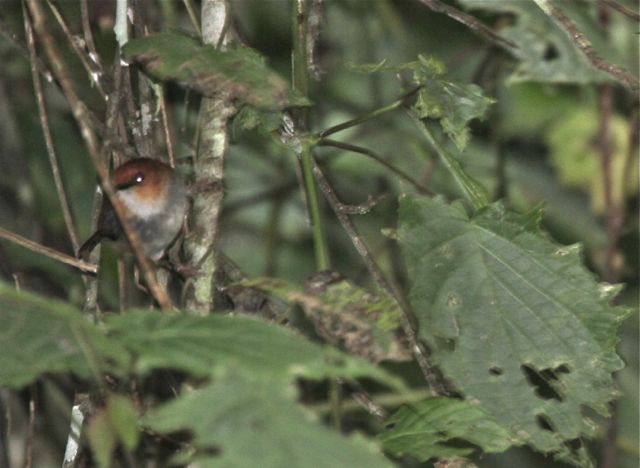
One of the unusual sightings was the termite colonies that we found in many trees. You can see the "runways" they build to get up the trunk to their home. In the same area where this photo was taken we were able to "call in" a pair of the endemic long-billed tailorbirds.
At one point we found an African crowned eagle soaring overhead (photo taken by Bob).
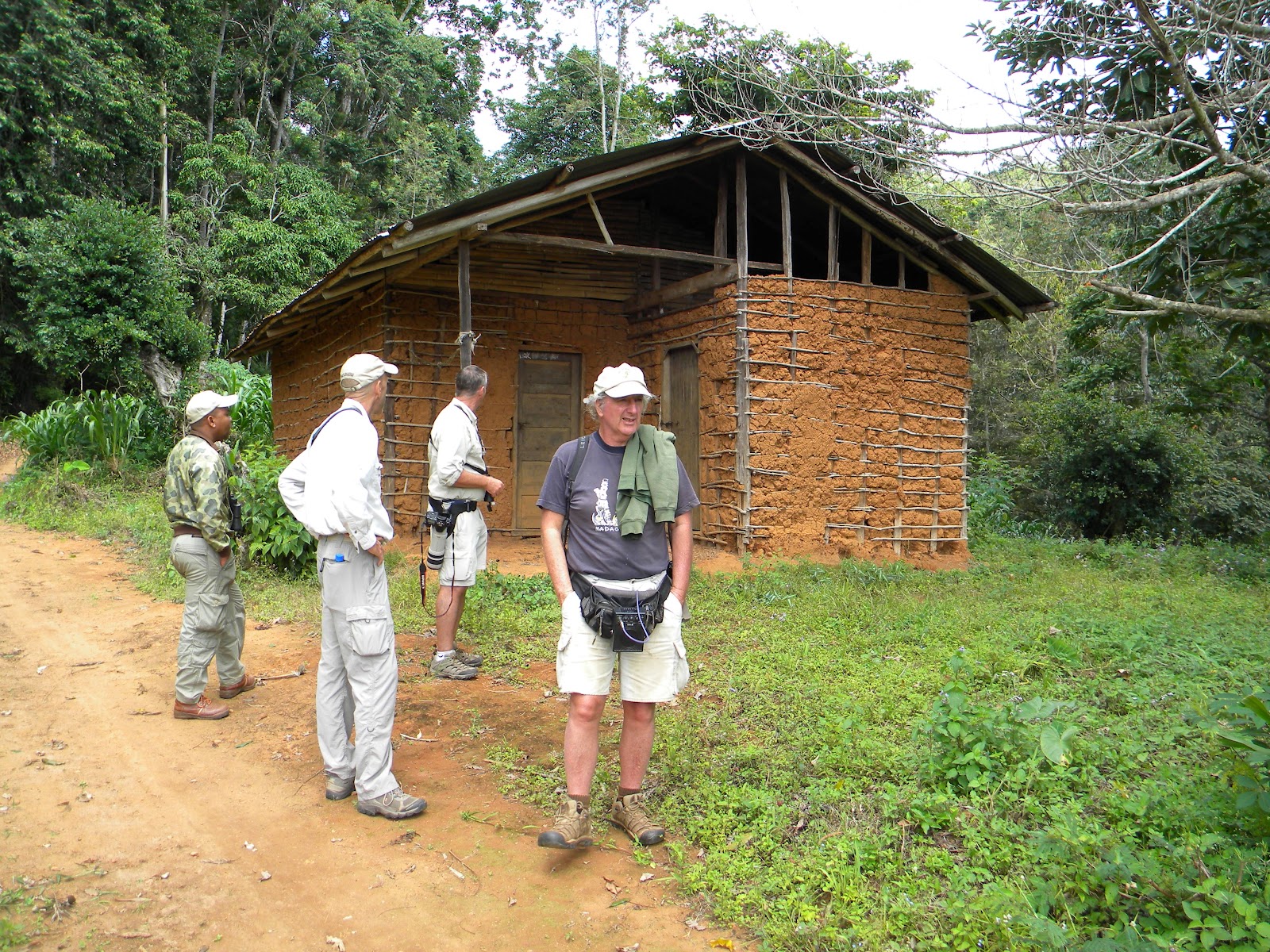
While in the towns and cities you see lots of homes and buildings built with bricks or stone, the vast majority of the housing particularly in the countryside is made of "sticks and wattle". In the photo below Brian is wearing the fanny pack, Stu is to his left, Bob is closest to the house, and to the far left is Anthony who was a local bird guide who joined us for the day.
As we walked around the area, we kept seeing lots of birds including the green-headed oriole just above (photo taken by Bob). At one point we walked through a beautiful garden area which my wife would have loved seeing in person.
One of my favorite bird families is the kingfishers of which E. Africa has 15 different species including the brown-hooded in the photo just below.
Another bird family that we do not have in the U.S. is the honeyguides. In the photo just below taken by Bob is a lesser honeyguide, our first for the trip.
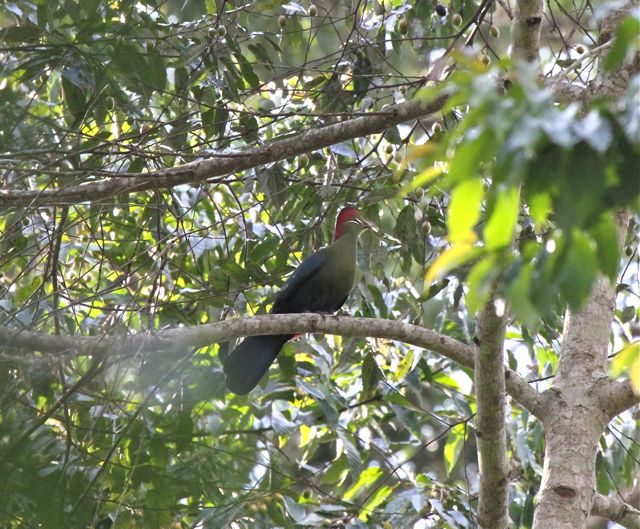
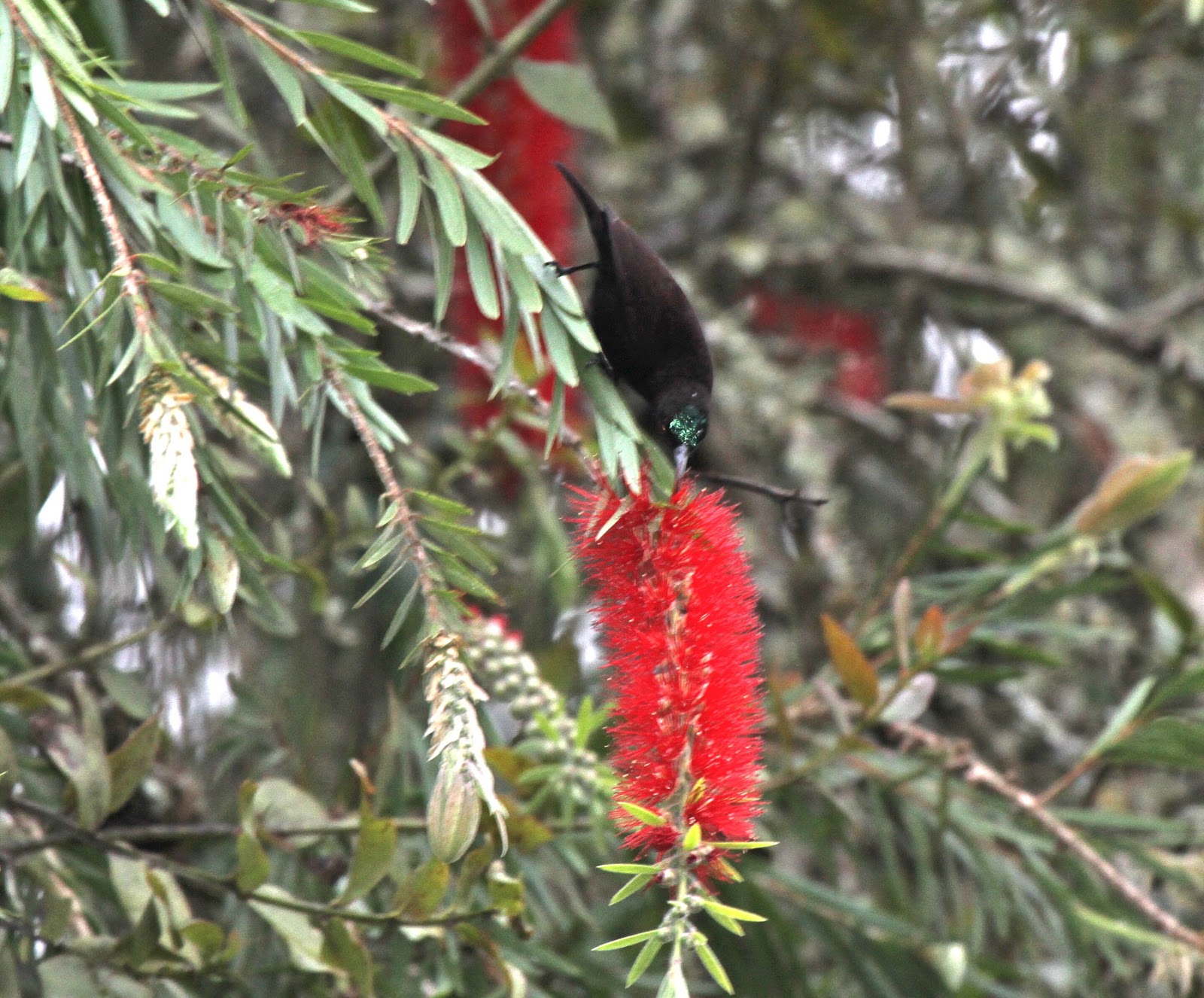
Another lovely sunbird is the purple-banded just above. The turacos--Fischer's in the photo just below (both photos taken by Bob)--is a extremely colorful family of 10 bird species that does a very good job of hiding in trees given its size (16-30 inches). Fortunately their calls are quite loud which helps you locate them in the dense foliage.
After wandering around all morning, we returned to our lodge for lunch--a welcome break from our poor box lunches. After eating, we spent the next couple of hours just hanging out around the lodge, birding on our own. This was the first time on the trip that we "slowed down" enough to do this. It was great being able to bird solo and study the birds that were nearby.
Mid afternoon we got back into the landcruiser to drive to a nearby area to look for some more new birds. Enroute we enjoyed watching the extremely colorful malachite kingfisher feeding along a stream. We also found a southern-banded snake eagle perched in a tree (both photos by Bob).
We drove by several hillsides that were planted with tea, plus the tea "factory" where they process the tea leaves.
Our key target bird for the afternoon was the half-collared kingfisher because Amani was the only area we were going to visit that the species could be found. As we drove slowly along a stream we head one calling, but did not find it. On our way back home near the same point where we had heard it calling, Bob amazingly in the dwindling light picked one up sitting on a rock (photo taken by Bob).
We found it just in time to make it back to our lodging area to do an olive ibis stake out. The olive ibis is a woodland ibis, and is very difficult to see. Anthony told us that at dusk most days a few fly by at one vista point on their way to an evening roost site. It was quite chilly as we patiently waited for them to come by. Just below where we were watching was someone's home with a large satellite dish behind it. I said before coming on this trip that I thought the only real difference I would find between today and 40 years ago when I came to Uganda was the addition of communication technology like satellite dishes, cell phones and the internet. As it turned out, I was right.
Finally about 6:30 as the light was almost gone we heard, and then saw at some distance the olive ibises fly over the treed ridgeline.
Our last bird of the day was not the olive ibis. One of the endemics at Amani is the Usambara eagle-owl. Brian had only seen this owl twice before. We got our "torches" and walked a short distance to a spot where the eagle-owl had nested in the past. We played a tape, and at first heard no response. Then we began to hear a call that sounded similar but not a perfect match. It was close by, then it seemed further away, and then it was close by again. We kept using our flashlights to scan the trees around us, and finally saw what looked like an owl very high up in a tree. Because it was so still, it took us about 10 minutes to confirm that it was a juvenile owl making an abbreviated call.
We decided to be happy with finding the juvie, and had started to walk away when we heard an adult calling. We were able to see it fly into a tree nearby, and then we heard a second adult calling. The juvie's calling had brought in its parents. Most amazingly, as we shined out torches on the one adult owl, the second adult flew in and mated briefly with the first. Brian had never seen eagle-owls mating. Between the mating owls, and the overall success of bird finding during the day, Brian said it was the single best day of birding he had ever had in the East Usambaras.
We practically floated back up the hill to our lodge where there was still no electricity. We did have enough water heated by the stove for all of us to take spit baths before eating another simple meal by candlelight. After doing the bird list update, we found we had passed 300 different species seen and/or heard. And tomorrow we were heading to Pemba Island. Stay tuned!
Saturday, August 18, 2012
Day 5--Travel Day to the East Usambara Mtns
Time to talk a bit more about Brian Finch, our bird guide. Brian was born in Kenya in 1950, and went to England to attend school. He made his way to Australia by age 20, beginning his serious birding in his travels to reach Australia. After working and birding in Australia for 9 years, he then moved to New Guinea where he spent the next 9 years working, and birding. He met the owners of Abercrombie and Kent in New Guinea, and they asked him to come back to Kenya to live at the Masai Mara and be a guide for the company. He spent 9 years working for A&K, and then moved to Nairobi where he has resided ever since, working for several bird tour companies as a guide in E. and S. Africa.
Brian's E. Africa life list is at 1039 different species seen, and his world list is between 6-7,000 bird species. He knows 3-4,000 bird songs/calls. As I said earlier in the blog, without his ear to pick up birds first, we would have seen far fewer total bird species on our trip. And since Stu only counts seen birds on his life list, and because we all prefer seen birds to heard only birds, we spent a fair amount of time in getting visual confirmation on as many of the heard first birds as we could.
One of Brian's distinctions beyond his vast birding skills and knowledge is that he is one of 1200 Kenyan citizens of European heritage. There are 42 million people living in Kenya, 9 million in Nairobi alone. Also, for all of you who have seen the movie, Out of Africa, some of the furniture including Meryl Streep's bed in the movie, were provided by Brian's family. It turns out that there is a registry in E. Africa where people list the period furniture they are willing to rent to film companies. His family's furniture has been used in several movies over the years, but back to birding.
We awoke to another nice morning at the Muller Mountain Lodge. As we walked in to have breakfast we began our day with amethyst sunbird (photo just above--all photos in today's post were taken by Bob). We also saw brown-backed mannikins just below.
One of the general images that I carry from our trip because we saw this every day was of E. Africans carrying objects on their heads including huge bundles of firewood. Most of the bundles were riding on women's heads, but we also saw lots of children carrying loads, and the occasional man except for the Masai men who do very little work of any kind other than to tend their cows, sheep and goats, or dress up in their traditional garb in hopes that tourists will pay them for a photo.
As we worked our way back down the winding road from the Muller Mountain Lodge, we had the opportunity to bird along the stream that ran next to the road. One of the bird species we saw several times was the cliff chat just above. We also passed a "road crew" that was mowing the roadside using machetes that had the last 4 inches bent so they could be used like a sickle.
Once we got back to the lowlands, we made pretty good time driving to the East Usambaras, with a stop every now and then to check out a new bird species like the lizard buzzard just above, and the black-winged red bishop just below--remember to click on any photo to enlarge it.
At one river crossing we saw another common sight, women washing their clothes. At one stop we saw our first African open-billed stork of the trip.
Our destination for the evening was the Malaria Research Center Resthouse in Amani which is high up in the East Usambaras. So we spent the end of our day winding up another mountain road. Between the curves, and the terribly rutted sections of some of the dirt roads, it was not unusual for us to travel only 20 KM/hr. Along the way we found a few more birds including a yellow-throated wood warbler just below.
Once again we arrived at our evening's lodging at dusk, but tonite we discovered that there was no electricity--the power had been out for over 24 hours--and the lodge did not have its own backup generator. Our evening was spent without the benefit of a hot shower, and we ate a simple meal by candlelight. As a result, we all were in bed pretty early, sleeping under our mosquito netting. Tomorrow was all about the unique forest birds of the East Usambaras. Stay tuned!
Friday, August 17, 2012
Day 4--West Usambara Mountains
The West Usambaras are part of the Eastern Arc Mountains located in southeastern Kenya and northeastern Tanzania. I happened to read a short article yesterday in Living Bird about the Eastern Arc Mountains being a key biodiversity hotspot for conservation priorities. We specifically visited both the West and East Usambara Mountains as part of our mega tour because of the endemics that can be found there. The article pointed out that while these mountains are not on most eco-tours, there are nearly 100 endemic species of birds, mammals, reptiles and amphibians.
We were up at first light which is 6 AM everyday in July since you are on the equator. Similarly, it gets dark by 7 PM everyday. Before breakfast we found red-winged, Waller's, and Kendrick's starlings, white-naped ravens and common fiscal outside our rooms. Breakfast had the usual "suspects"--eggs, sausage, potatoes, toast with butter and jam--but also a very good homemade muesli with yogurt.
It was a largely overcast day--our first of the trip. The weather so far had been surprisingly good with very comfortable temps and humidity. Many people had asked me before leaving on the trip how hot it was going to be. As it turned out, most days were not all that warm, and it was never as bad as the 100 degree, high humidity days that occur regularly in July in Chapel Hill, NC where I live. In the morning and the evening it was often cool enough that a light fleece was needed. The overcast weather had no effect on the silvery cheeked hornbills in the photo above taken by Bob. One of the things we learned early on during the tour was that Brian had alternative names for birds. He called this hornbill saliva cheeked.
There is still a small amount of native forest left in the West and East Usambaras, so we drove a short distance to what had been an old logging road that we could walk slowly up and down looking and listening for birds in the "true forest remnants" that somehow had not ended up being logged. The birding proved to be very difficult because of the thick vegetation, but we did encounter several groups of Angola colubus monkeys during the day.
Since Bob, Stu and I had never birded E. Africa, at the beginning of the trip we were very dependent on Brian to point out what we were looking at, and in the case of forest birding, what we were hearing. Birder friends of mine, who have birded extensively in South and Central America, had told me how frustrating it can be to keep hearing birds singing/calling, but then not be able to see them. This makes having a guide so important because the best of them know the bird songs/calls. Brian has been birding in E. Africa for almost 30 years now, and he knows all the bird songs/calls. Without his help, we would have been largely clueless as to what we were hearing. As the trip went on, we did get a bit better on picking out some bird songs/calls that we heard more regularly, but we never really got very good at it. We did do better on the visuals, but keeping the various names straight was a continual challenge.
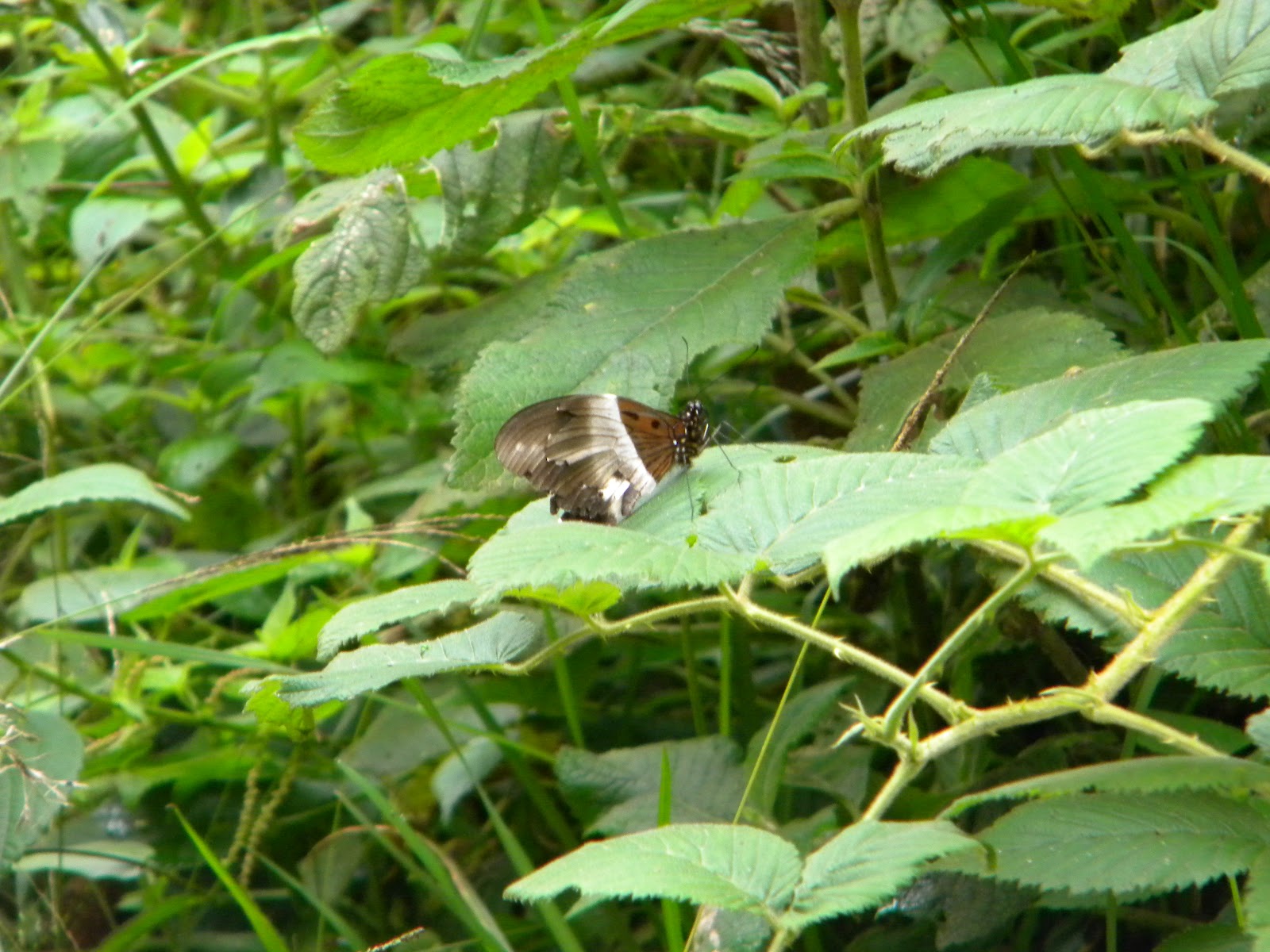
As we walked the road we did slowly begin to see some birds either because they finally came out in the open like the bar-throated apalis just above (photo taken by Bob--click on any photo to enlarge), or by playing a tape of a bird's song/call to draw them out into the open. It was much easier to see the many butterflies once it warmed up enough for them to fly about.
There are so many bird families in E. Africa that we do not have in North America including the bushshrikes which are very colorful like the black-fronted in the photo just above taken by Bob. We also found Fulleborn's black boobou (photo just below taken by Bob) which is an endemic to the Eastern Arc Mountains.
We did not spend all our time looking up, otherwise we would have missed ground creatures like the 6 inch long centipede that we encountered on several occasions during our trip (photo taken by Bob).
One of the birds we had to work quite hard to get to show itself was the African tailorbird (photo just above taken by Bob). This species is almost endemic to Tanzania, and the long-billed tailorbird is extremely rare and only found in the East Usambaras. Some other new birds on day 4 of our trip that stood out included mountain buzzard and crowned hawk-eagle; olive pigeon; Hartlaub's turaco--one of E. Africa's most colorful bird families; red-rumped swallow, mottled spinetail and black sawwing; cape robin-chat; bar-tailed trogon; mountain wagtail; green barbet and moustached tinkerbird; African dusky flycatcher; yellow-throated wood-warbler; African hill babbler; and African yellow white-eye.
Walking the logging road gave us our first day of dealing with one of E. Africa's family of skulkers--the greenbuls. Bob was moaning throughout the day about how impossible it was to get a photo of a greenbul. We even had a difficult time just getting short glimpses of the Shelley's, eastern mountain, stripe-cheeked, yellow-streaked and placid greenbuls hiding in the foliage. We did finally get identifiable views of another tough bird--the red-faced crimson-wing, but no photo. But Bob did get a photo of the White-tailed crested-flycatcher in the photo just below.
As we were walking back down the logging road towards the end of the afternoon, Brian (in the cap) explained to us that the banana like plant that Bob is holding onto is the source of the many types of bananas now grown throughout E. Africa. We ate some kind of banana every day of our trip--it was one of Bob's favorite snacks.
Another night was enjoyed at the Muller Mountain Lodge where dinner once again was nourishing but nothing to rave about. Tomorrow we make the drive over to the East Usambaras. Stay tuned!
We were up at first light which is 6 AM everyday in July since you are on the equator. Similarly, it gets dark by 7 PM everyday. Before breakfast we found red-winged, Waller's, and Kendrick's starlings, white-naped ravens and common fiscal outside our rooms. Breakfast had the usual "suspects"--eggs, sausage, potatoes, toast with butter and jam--but also a very good homemade muesli with yogurt.
It was a largely overcast day--our first of the trip. The weather so far had been surprisingly good with very comfortable temps and humidity. Many people had asked me before leaving on the trip how hot it was going to be. As it turned out, most days were not all that warm, and it was never as bad as the 100 degree, high humidity days that occur regularly in July in Chapel Hill, NC where I live. In the morning and the evening it was often cool enough that a light fleece was needed. The overcast weather had no effect on the silvery cheeked hornbills in the photo above taken by Bob. One of the things we learned early on during the tour was that Brian had alternative names for birds. He called this hornbill saliva cheeked.
There is still a small amount of native forest left in the West and East Usambaras, so we drove a short distance to what had been an old logging road that we could walk slowly up and down looking and listening for birds in the "true forest remnants" that somehow had not ended up being logged. The birding proved to be very difficult because of the thick vegetation, but we did encounter several groups of Angola colubus monkeys during the day.
Since Bob, Stu and I had never birded E. Africa, at the beginning of the trip we were very dependent on Brian to point out what we were looking at, and in the case of forest birding, what we were hearing. Birder friends of mine, who have birded extensively in South and Central America, had told me how frustrating it can be to keep hearing birds singing/calling, but then not be able to see them. This makes having a guide so important because the best of them know the bird songs/calls. Brian has been birding in E. Africa for almost 30 years now, and he knows all the bird songs/calls. Without his help, we would have been largely clueless as to what we were hearing. As the trip went on, we did get a bit better on picking out some bird songs/calls that we heard more regularly, but we never really got very good at it. We did do better on the visuals, but keeping the various names straight was a continual challenge.
As we walked the road we did slowly begin to see some birds either because they finally came out in the open like the bar-throated apalis just above (photo taken by Bob--click on any photo to enlarge), or by playing a tape of a bird's song/call to draw them out into the open. It was much easier to see the many butterflies once it warmed up enough for them to fly about.
There are so many bird families in E. Africa that we do not have in North America including the bushshrikes which are very colorful like the black-fronted in the photo just above taken by Bob. We also found Fulleborn's black boobou (photo just below taken by Bob) which is an endemic to the Eastern Arc Mountains.
We did not spend all our time looking up, otherwise we would have missed ground creatures like the 6 inch long centipede that we encountered on several occasions during our trip (photo taken by Bob).
One of the birds we had to work quite hard to get to show itself was the African tailorbird (photo just above taken by Bob). This species is almost endemic to Tanzania, and the long-billed tailorbird is extremely rare and only found in the East Usambaras. Some other new birds on day 4 of our trip that stood out included mountain buzzard and crowned hawk-eagle; olive pigeon; Hartlaub's turaco--one of E. Africa's most colorful bird families; red-rumped swallow, mottled spinetail and black sawwing; cape robin-chat; bar-tailed trogon; mountain wagtail; green barbet and moustached tinkerbird; African dusky flycatcher; yellow-throated wood-warbler; African hill babbler; and African yellow white-eye.
Walking the logging road gave us our first day of dealing with one of E. Africa's family of skulkers--the greenbuls. Bob was moaning throughout the day about how impossible it was to get a photo of a greenbul. We even had a difficult time just getting short glimpses of the Shelley's, eastern mountain, stripe-cheeked, yellow-streaked and placid greenbuls hiding in the foliage. We did finally get identifiable views of another tough bird--the red-faced crimson-wing, but no photo. But Bob did get a photo of the White-tailed crested-flycatcher in the photo just below.
As we were walking back down the logging road towards the end of the afternoon, Brian (in the cap) explained to us that the banana like plant that Bob is holding onto is the source of the many types of bananas now grown throughout E. Africa. We ate some kind of banana every day of our trip--it was one of Bob's favorite snacks.
Another night was enjoyed at the Muller Mountain Lodge where dinner once again was nourishing but nothing to rave about. Tomorrow we make the drive over to the East Usambaras. Stay tuned!
Thursday, August 16, 2012
July 3--Arusha to the West Usambara Mtns
A bit more background on why we took this trip. Bob, who organized it, had told me ever since we reconnected in 2010 that he really wanted to bird more outside of the ABA area. He still had as a goal to see at least 5000 different bird species from around the world, as well as see some more cultures. He is about to turn 56 and has had skin cancer, so he really wanted to get this particular mega birding trip done sooner than later. After I shared my interest in this kind of trip, plus having heard from Luddy Lamberton how great the trip had been for him, Bob decided that 2012 was the year to go. Because Bob owns and manages a nursery, the summer was the only time for him to do this trip.
Stu, who recently moved to Sarasota, FL after living in Austin, TX for the past 25 years, has birded around the world a fair amount. From 1996-2002 Stu helped organize adventure tours outside the U.S., mostly in New Zealand. He had already been to S. Africa twice, and definitely wanted to see the E. African birds that did not make it to the tip of Africa. The gorilla trekking day sealed the deal for him.
So the 3 of us were all set to go by early March, but we kept seeking out other possible birders to join us with a goal of having 6 of us to help reduce the trip costs. Between the length of the trip, and the overall cost, we were unable to add any other birders to the group. As it turned out, even though it meant we each paid $2-3,000 more than if we had 4-6 people in our group, it all worked out very well because traveling in the landcruiser was much more comfortable having just the 3 of us plus Brian and a driver. The ideal number of birders would have been 4.
We were up early in Arusha to get a good start on our day. Outside our hotel a lanner falcon flew over to get our birding day off on a high note. We had to drive some distance to reach a large manmade lake which is called a dam in E. Africa--only natural lakes are called lakes. We did not see all that many new birds in route, but since we had seen so many the day before at Tarangire, I decided to share a few of those photos to start this blog entry. Above is a bearded woodpecker taken by Bob, and below is a male common ostrich (click on any photo to enlarge).
One of the hornbills we saw at Tarangire is the gray in the photo above, and below is the very sharp looking namaqua dove, both taken by Bob.
Two more birds from yesterday were the silverbird above and the lilac breasted roller below, both taken by Bob.
The dam/lake was huge, and the area around it was quite arid, which gave us a chance to see many other family groups than we had seen at Tarangire. The little egret below is very similar to our snowy egret.
One of the bird families that I was looking forward to seeing in E. Africa is the barbets. There are over 20 members of the family, and they generally have large bills relative to the size of the bird. Bob was able to get a nice photo of a black-throated barbet. We also found D'Arnaud's barbet near the lake.
There were a large number of both white-winged and whiskered terns plus 1 gray-headed gull, 3 gull billed terns and about 100 skimmers. We also saw a few black winged stilts.
We saw a few spur-winged lapwings (photo below) and blacksmith lapwings. We found a few water thick-knees, another one of those unusual bird families found in E. Africa. As we were eating lunch, a flock of 25-30 black-tailed godwits flew over, but frustratingly they did not land where we could look at them thru our scope. They were one of the early returning palearctic shorebirds that we were able to see during the month. We also saw at some distance a madagascar heron. We saw lots of white faced whistling ducks, egyptian geese, great and long-tailed cormorants; some great and cattle egrets, gray and black headed herons, and sacred, glossy and hadada ibis.
A totally new plover for me was the Kittlitz's (photo below taken by Bob). We have Kittlitz's murrelets in Alaska, but no Kittlitz's plovers in the U.S.
Another bird we saw in the scrub near the Kampi ya Mungu Dam was the rufous chatterer (photo above taken by Bob). The new sunbird species for the trip was the black-bellied below also taken by Bob.
By mid afternoon we tore ourselves away from the dam to make the rest of our drive to the W. Usambara Mountains. We would occasionally stop along the road to check out a bird that Brian had spied as we rolled along. Often we would find other new species once we got out to walk around.
We wound our way up the mountain, arriving at the Muller Mountain Lodge at dusk. The lodge was originally a private home that was turned into a lodge and has 22 rooms to let. As we drove up the mountain we got good views of another lanner falcon. As we walked into the main building for dinner, Stu found near the top of a very tall pine a spotted eagle-owl, and soon after we found an Usambara nightjar. We walked into dinner feeling great after another very long day of birding and travel. Dinner proved to be one of our better meals, and afterwards we did the bird list update. After just 3 days of birding we had already passed 200 different species seen and/or heard. Stay tuned!
Subscribe to:
Posts (Atom)