Tuesday, September 18, 2012

Day 18--Castle Forest Lodge to Samburu

Our hopes of a dry morning were dashed when we awoke to mist and light rain.  As we walked up to the lodge for breakfast we found a Hartlaub's turaco (photo taken by Bob), and a red-fronted parrot.  Once we were on the covered porch, we birded for a bit while they made us breakfast.


The next new trip bird after the parrot was a pair of blue-headed coucals that flew thru the thick foliage below the porch.  Then Kandt's waxbill showed up and a northern double collared sunbird (photos just below taken by Bob--click on any photo to enlarge).  As we kept scanning the foliage several birds would make fleeting appearances.  Way down in the valley we also had a group of elephants slowly come into view and then walk on into the forest.


Breakfast proved to be the best of our trip--lovely crepes with real maple syrup accompanied by fresh squeezed oj, fried eggs, sausage and bacon.  This boded well for the prospects of our box lunch later in the day.   After eating we drove a short distance back down the road, and then got out to walk back up the hill in search of new birds.  Unfortunately not long after beginning the walk it began to rain in earnest, so after getting pretty wet, we gave up.  Just as we returned to the lodge area, an olive ibis flew over much to the surprise and delight of Brian (photo taken by Bob).


We walked back up to the "huts" to collect our baggage and found a rufous-chested sparrowhawk perched in a tree.  The rain continued to fall as we began the drive to Samburu.  The weather improved once we got down off the base of Mt. Kenya.  As we were heading north we passed one of the many signs all over Kenya where you cross the equator.


The drive to Samburu was fairly leisurely.  We located a few new trip birds like Boran cisticola, and little rock thrush (photos taken by Bob).


The highlight was a malachite sunbird (photo taken by Stu), which we had missed in the Aberdares where Brian would normally have expected to find it.  Our box lunch proved to be the 2nd best of the trip.


We had been at 7-8,000 ft elevation at Castle Forest, but by the time we reached Samburu we had dropped to between 3-4,000 ft.  As we entered Buffalo Springs, which is one of 3 national parks that is generally called Samburu, we saw our first reticulated giraffes ambling along.  Notice the 2 birds feeding on the back of the giraffe on the right.


Soon after we found a Wahlberg's eagle down on the ground, and close by was a Grevy's zebra.  Brian told us that the Grevy's is related to horses, but the much more common Burchell's zebra is related to donkeys.


We slowly worked our way thru the park in search of animals and birds.  The Donaldson-Smith's sparrow-weaver was a new trip bird that is a park speciality.  In the photo just above a white-browed sparrow-weaver is perched on the left side, and on the right is a white-headed buffalo-weaver.  Just below is a weaver nest.  This tree had 20+ nests hanging in it.


We found a large herd of Oryx feeding in the grass, and a Ruppell's long-tailed starling, a species we had first seen a few days earlier.


The sun was beginning to drop low on the horizon when we pulled up to the Simba Lodge that had been open only for a couple of years.  The place was easily one of my 3 favorite places that we stayed.  The rooms were large with balconies to sit and watch the wildlife.  The bathrooms were as nice as any you would see at a deluxe hotel in the U.S., and there was lots of hot water.

We had a good buffet dinner, and our table was near the lighted waterhole so we could watch the birds and animals that came in.  A slender-tailed nightjar would fly up every now and then from a hidden perch to catch bugs.  A gray-headed kingfisher perched in the open would make occasional forays.  Straw colored fruit bats would fly in and out of view.  Two waterbucks came to get a drink, and 2 white-tailed mongoose as well.  An elephant was bugling in the distance. We updated the bird trip list before heading to our rooms.  Tomorrow we got to spend the day wandering thru this magnificent NP.  Stay tuned!

Saturday, September 15, 2012

Day 17--The Aberdare Mtns

We were up early to walk the grounds of the Fish Eagle Inn.  Down by the lake we saw a gray-hooded gull fly by (photo taken by Bob).  I have also included a photo from the day before that Bob took of both greater (taller with pink and black tipped bills at the back of photo) and lesser flamingos.  We saw for the first time a giant kingfisher, and a new trip bird--a black-lored babbler.


We were on the road at 8:15 AM because we had a lot of ground to cover.  Our main focus for the day would be to cross the Aberdare Mountains.  On our way up to the park entrance, we found one of the most dramatic of the sunbirds--the golden winged (photo taken by Bob--click on any photo to enlarge).  We also saw 3 more new cisticola species--Levaillant's, Hunter's and wing-snapping; the endemic Sharpe's longclaw; and common quail.


We reached the park entrance before noon.  One of the rangers offered to take a photo of the 3 of us, but as you can see he managed to cut part of me and Stu off--oh well.


We slowly drove the gravel road, and over the many kilometers we traveled we ended up finding a few Jackson's francolins.


It was overcast and even spitting rain at times, but we kept finding birds as we went including the eastern double-collared sunbird, and the Aberdare cisticola (both photos taken by Bob).  Some animals we encountered included giant forest pigs, cape buffalo, wart hogs, water bucks, and mountain reed buck.


We stopped at one grassy open area that had some flowers blooming to look for sunbirds, and discovered a scarlet-tufted malachite sunbird that was too far away in poor light to get a photo.  We did have a very cooperative long crested eagle show off for us (photo taken by Bob).


As we were leaving the park it was a bit foggy, and several birds were feeding along the road including 2 new trip birds--scaly francolin, and Ruppel's robin-chat.  It was already late afternoon, and it was threatening to rain.  As a result, rather than taking a detour to try for another endemic--Hinde's babbler--we drove straight to Castle Forest Lodge which is on Mt. Kenya.  The modest stone and wood main building was built 65 years ago for Queen Elizabeth when she came to visit Kenya.

It was all but dark when we started up the dirt road to the lodge.  Suddenly out of the forest walked a mother elephant and her offspring, stopping in the road just in front of us.  We stopped the landcruiser, and even slowly backed up so as not to upset her.  After a minute or 2 they moved on into the forest, but then another adult elephant came out of the forest, crossed the road and followed the first 2.  We waited a couple of minutes to make sure there were no more before driving on up to the lodge.

We were the only guests that night, so our driver, John, joined us for dinner.  John does not talk much when he is driving, so it was a treat to be able to have a lengthy conversation with him about himself and Kenya while we ate. He also told us that last year a mother and her child were walking near the lodge when they came across an elephant.  They tried to run away, but were trampled and died.  As a result, now all guests must be accompanied by local guides.

After dinner we did the bird list update, and found that we had seen 30 more new trip birds.  We walked up the hill in the rain to our cottages to find a fire burning in the fireplaces.  We went to sleep hoping that the rain that had fallen all day at the lodge would stop by tomorrow.  Stay tuned!

Saturday, September 8, 2012

Day 16--Masai Mara to Naivasha

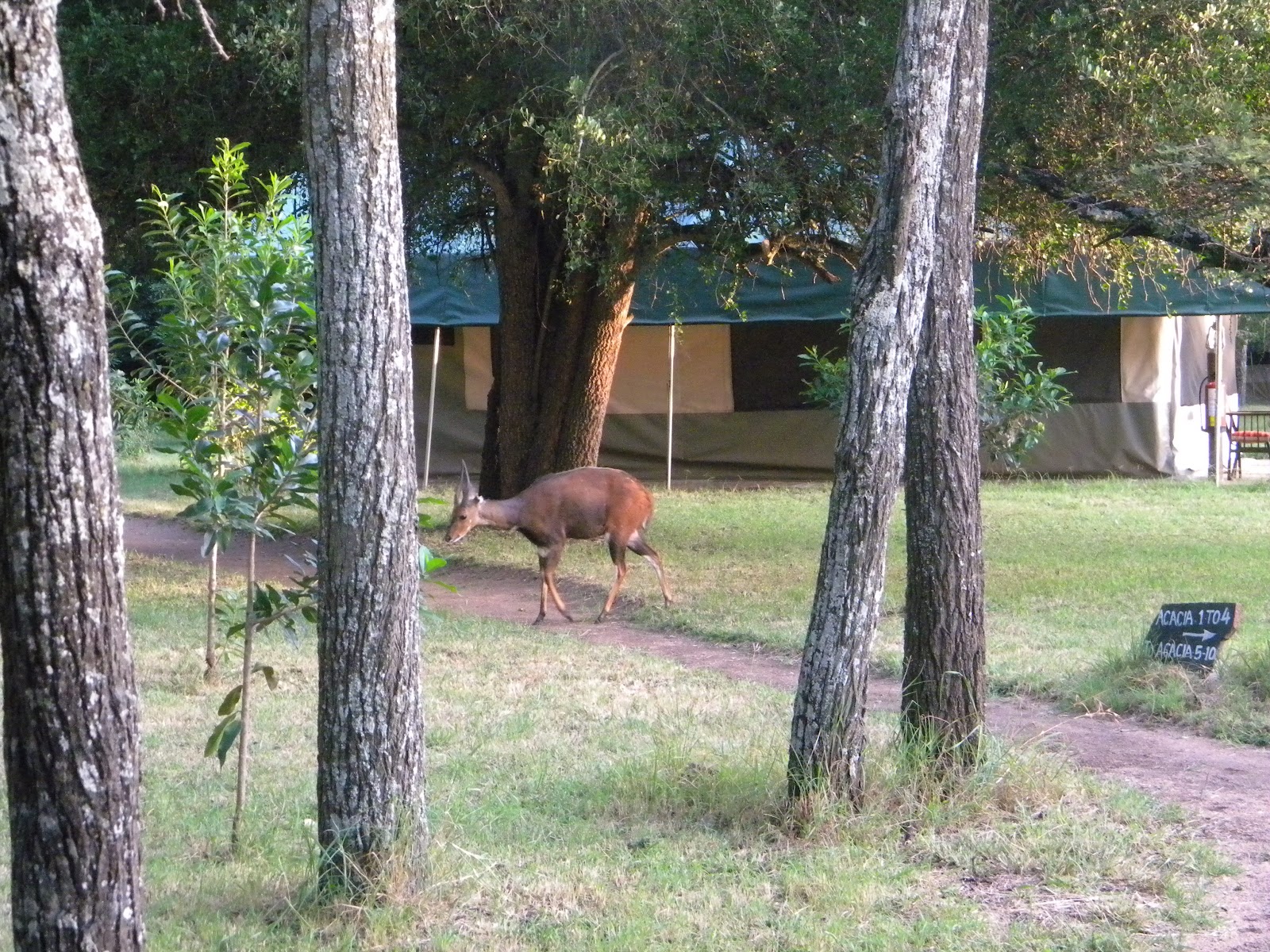
We were up early to bird the lodge grounds before breakfast. Where I live in North Carolina I see white tailed deer regularly in my yard.  At Siana Springs there were bushbuck grazing around the tents.  There were also baboons on the grounds, so we had to tie our tents shut because the baboons had figured out how to work the zippers but not the tied strings. We heard and saw quite a few birds, including some new ones like tropical boubou, and Holub's golden weaver.  At one point we thought we had found a Verreaux's eagle-owl on a nest, but it was somewhat obscured, and once we we were able to get clear looks at it we realized that it was a white-backed vulture hunched over.


After breakfast we began the long, slow drive to Naivasha.  As we were leaving the lodge area we found several Usambiro barbets, a new trip bird (photo just above taken by Bob).  The first part of the day was spent being bounced around in our seats as we worked our way out of the Mara on some really bad roads.  We would see the occasional Masai village with the bomas (corrals) where their cattle spend the night.  But what stood out way too often was the vast number of plastic bags that littered the landscape around the villages.


We kept finding a few new birds as we made our way to Naivasha including the long-tailed widowbird just above (click on any photo to enlarge), and the cape rook just below.


We also found brown-backed scrub-robin, Schalow's wheatear, northern anteater chats just above, and a white-headed sawwing just below (photo taken by Bob).


We arrived in Naivasha mid afternoon as it began to rain.  We drove down to the lake in hopes that the rain would be short lived.  It was not raining all that hard, but it kept up for quite some time.  As a result, it was difficult for me to get good photos of the greater and lesser flamingos, and the African spoonbill.  A hamerkop did perch on a rock for us.  By the time the rain stopped it was near dusk, so we made the short drive to the Fish Eagle Lodge where we spent the night.


On the way to the lodge we drove by row after row of greenhouses used to grow cut flowers.  My sister-in-law, who is a sustainable farmer with my brother here in North Carolina, had the opportunity to visit Naivasha a few years ago to see the cut flower business.  The growers in Naivasha ship flowers daily by air to Holland for distribution to Europe and beyond. For someone who grows flowers for local markets, what she experienced at Naivasha must have been mind boggling.

The Fish Eagle Inn proved to be adequate as far as accommodations and food.  It was still lightly raining as we finished up our day by updating the trip bird list.  Amazingly at the half way point of our trip we had already passed 500 different species seen and/or heard.  I will be out of town for the next few days, and when I return Bob will have been able to get me many more new photos to share with you.  Stay tuned!

Thursday, September 6, 2012

Day 15--The Masai Mara

We were up early again to eat a quick breakfast before driving 30 minutes to the Wilson airport to catch the flight to the Masai Mara.  While at breakfast we kept hearing a giant kingfisher calling down by the river below the lodge, but it never flew into view.

We caught our flight at 10 AM, and even had to change planes at one of the 8 Masai Mara landing strips before meeting John and our landcruiser at Kitchwa Temba where Brian had lived for nine years as a guide when he first returned to Kenya in the 1980's.  We had made the relatively short flight to the Masai Mara so that we could experience seeing the park from the air.  It was very dramatic flying over it, seeing herds of elephants and wildebeest, and groups of hippos in the river.  It was also strange to see herds of Masai cattle mixed in with all the wild animals.  Flying over the savannah in our small prop plane reminded me of flying in bush planes in Alaska.  Once on the ground, the huge open vistas of the savannah made me think of traveling thru parts of Montana.

We loaded up our gear and headed up into the hills first to look for a few birds in that habitat.  We stalked a Schalow's turaco for quite some time, but in the end only got fleeting views of it.  A trilling cisticola also proved elusive but it finally did give us pretty good looks.


We next headed down to the river, driving thru some grasslands on the way. We were looking for hippos, and soon found a few that were mostly submerged in the muddy water. We also saw more Masai cattle grazing just behind an elephant and a zebra.  At this same spot we were able to see in the distance several rufous-bellied herons flying low over the marsh area--the only place to see them in Kenya--and a little bittern also flew by. 


Since it was well past noon, we parked under one of the trees along the river to eat another less than wonderful box lunch.  While eating, a Masai warrior came up to the truck to check us out.  Stu asked John if he would talk with the man about Stu taking a photo of him wearing an Austin City Limits t-shirt in exchange for the t-shirt.  He agreed to do it, so Stu got a very memorable photo for the trip.  I got a shot of a lilac-breasted roller (click on any photo to enlarge).  Bob and I each bought a necklace for our wives, and shared part of our lunch with the man.


While driving thru the many miles of the savannah we heard from Brian about the Masai Mara, and the Masai who control it.  The Masai Mara National Reserve is in southwestern Kenya, and was initially established in 1948. It has grown in size over the years to where it now covers almost 600 sq. mi.  To the south is the Serengeti NP in Tanzania, and the animals move back and forth as the dry and rainy seasons come and go.

Roughly 2000 tourists visit the reserve each day throughout the year, each paying $80/day to be in the reserve (we each had a plastic "bank" card with approximations of our names--Thomas Hilt, Stuart Stuart, and Robert Wollners--that was used to enter the reserve).  Part of each night's lodging fee also goes to the Masai.  That means the Masai take in about $70 million a year from fees.  While it is wonderful to see the animals, it is not clear where all that money goes because the wild animals take care of the themselves, and the dirt roads are horrendous.  At the end of the day I felt like I had spent hours riding a bucking bronco, or should I say a bucking wildebeest. 


The weather was nearly perfect--low humidity, 70's and sunny.  We had the top of the landcruiser up to be able to stand and watch the animals while bouncing along, and to protect us from getting sunburned.  Our first spotted hyena of the trip showed up mid afternoon.


Other than along the river, we did not see much water, but at one small wet area we did find a greater painted snipe.


One of the unique animals in the Mara, as the locals call it, is the topi whose coloring on its legs was quite distinctive.  We did see a lioness near a partially eaten wildebeest which was pretty gross visually so we passed on taking a photo of it.


Our day seemed to end all too quickly as we had so enjoyed the magic of the Mara.  We arrived at Siana Springs Lodge in the dark where we would spend the night in large tents, each having its own bathroom facilities.  Dinner was one of the best of the trip, and included a very good bottle of 2003 Simonsig pinotage from South Africa.  We fell asleep listening to hyenas and baboons in the distance.  Stay tuned!

Monday, September 3, 2012

Day 14--Nairobi NP

We were out again by 6:30 AM looking for birds around the Masai Lodge.  We had heard lions growling during the night. As it got lighter we began to find more new trip birds like chin-spot batis, and olive thrush.  We ate breakfast pretty quickly so that we could start our morning of exploring Nairobi National Park which was created in 1946 as Kenya's first national park.  It is right on the edge of the city, and covers almost 29,000 acres.  It felt quite strange traveling thru the park because you regularly had views of buildings that are along the edge of the park, plus Nairobi's secondary airport abuts the park so there are planes flying quite low over it.  One of our first birds in the park was a purple grenadier (photo taken by Bob--click on any photo to enlarge).


We spent until mid afternoon winding our way thru the forest and savannah on dirt roads.  We did see some other tourists, but Brian said the park is not that heavily visited even though it is so close to Nairobi.  We found a nice martial eagle, and a lovely variable sunbird (photos by Bob).


We came across a giraffe eating its way thru the trees, and a hartebeast juxtaposed with one of Nairobi's large buildings.


It seemed like we were constantly stopping to study either new birds or animals.  At one point we found 4 white rhinos feeding, but they were too far away to get good photos.  Lots of long tailed fiscals were spread throughout the park.


We had seen very few lions during the trip, so it was nice to find a mother and her offspring.


We had seen distant views of 2 secretary birds at Tarangire NP, so we were thrilled to have one walk across the road right in front of us.  Bob also got a nice photo of a Klaas' cuckoo.


The bird family of the day was the cisticolas which we jokingly called the coca colas.  There are over 30 different cisticola species, and by the end of our time in the park we had seen and/or heard 9 of them of which 4 were new trip birds including the stout cisticola just above.  We also found an African water rail just below (both photos taken by Bob).


While there were not huge numbers of animals in the park, we often found small groups like impalas.  Brian said that the numbers of animals fluctuates with the rainy and dry season migrations. At one small wetland we found black crakes, grosbeak weavers, and zebra waxbills--all new trip birds--plus 2 sacred ibis and an egyptian goose.


Bob also got photos of a malachite kingfisher and 3 cardinal quelea.


Even though cape buffalo are widespread, we finally saw our first of the trip at Nairobi NP.


The lodge did not make us a box lunch, but since we were on the edge of the city, we met one of the ground agents for our trip at the main entrance gate who had brought us lunches from a place call Dorman's.  It proved to be the best lunch of the trip--a chicken tikka or club sandwich with a nice green salad.

We then worked our way back thru the park to be able to make the drive to a place called Magadi Rd. which had some good habitat for finding  Lynne's and tiny cisticolas--both new trip birds. One of the more dramatic bird families are the whydahs because the males when breeding have very long tails (pintail whydah photo by Bob).  We also saw another new trip bird--red and yellow barbet-- along the road.


As the light began to fade, we headed back to the Masai Lodge for one more night.  Dinner was pretty much a repeat of the night before, ordering off the menu.  We did the bird list update, and found we were getting closer and closer to 500 different species seen.  We went to bed looking forward to flying to the Masai Mara the next day.  Stay tuned!